


SKU #3693
·
853 views
Olivier de Serra
Pear
User rating
1 vote100% positive reviews
No ratings yet — be the first.
Type of Sort
Winter variety of pear
Prices in stores
from1.17 €per seedling
pack from 4.25 € per pack
4 offers from 3 stores
Store offers · 4 from 3 stores
Prices are updated on loadLoading offers…
Available at: Evrosag · Приватний плодорозсадник Таміла · Vinsad
Aggregator catalog: prices are collected automatically from store websites, normalized by AI and converted at the current exchange rate. Before ordering, confirm the price and availability on the store's website. This block is not indexed by search engines — the data is loaded after the page opens.
About product

The originator A. T. Buabynel introduced this winter variety in 1847 (France). It was named Olivier de Serra, whom the French called the father of agriculture. The variety is registered in the North Caucasus region, Ukraine, and Moldova. Medium-sized tree; young trees have a tall, compact pyramidal crown, while mature trees have a broad pyramidal crown with more spreading branches. Main scaffo…
Type of Sort
Winter variety of pear
Description
The originator A. T. Buabynel introduced this winter variety in 1847 (France). It was named Olivier de Serra, whom the French called the father of agriculture. The variety is registered in the North Caucasus region, Ukraine, and Moldova.
Medium-sized tree; young trees have a tall, compact pyramidal crown, while mature trees have a broad pyramidal crown with more spreading branches. Main scaffold branches are short and thick, branching off the trunk at a 45-50° angle. Bark of branches is brown, smooth, and peeling on the trunk.
Buds are medium-length, dark brown, short, curved, hairless; many flower buds. Buds are large, conical, and raised. Leaves are glossy, lanceolate or elongated-oval, with uplifted wavy edges, curved along the central vein, positioned perpendicularly to the twig. Leaf blade is pointed, deeply lobed, with finely toothed margins.
Flowering is medium-early.
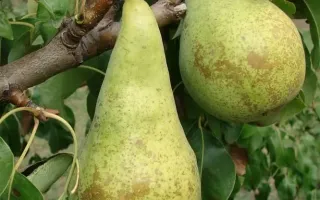
Fruits are medium-sized, up to 150 g, sometimes larger. Shape is flat-round, bergamot-like, with a bumpy surface, especially around the calyx. Skin is slightly rough, dense, gray-green, covered with brown spots and patches, forming continuous rusty spots at the base and tip. At maturity, skin turns dark yellow, sometimes with slight blush on the sun-exposed side. Pedicel is short, thick, slightly curved, with a flared top. Pit is large and deep. Calyx is nearly closed, seated in a deep, spacious, slightly ribbed cup. Heart is medium-sized, oval, chambers small and closed; seeds are elongated-pointed, brown.
Flesh is creamy, very juicy, dense, melting, sweet with a slight almond flavor, aromatic, with slight granulation around the seed cavity. In terms of taste quality, this is one of the best late-winter pear varieties. Taste score: 4.5 points. Under Kuban conditions, fruits contain: sugars — 8.9%, titratable acids — 0.44%, dry matter — 15.4%, ascorbic acid — 4.6 mg/100g, P-active catechins — 42.0 mg/100g dry matter.
Fruits remain firmly on the tree. Harvesting maturity occurs in the first decade of October; consumer maturity in December. In storage, they remain until March. For optimal winter storage, harvesting should be done as late as possible, considering weather conditions.
Fruits are transportable and firmly attached to the tree. Primarily consumed fresh, though suitable for making compotes.
Partially self-fertile. Best pollinators: Williams, Klapa's Favorite, Winter Dekanka.
Grows and fruits on quince, though it is advisable to use intermediate grafting when propagating saplings.
Trees grafted onto pear begin fruiting at 6-7 years, those grafted onto quince at 4-5 years. Yield is moderate. Winter-hardy, but very demanding in soil-climatic conditions. Olivier de Serra trees require a sheltered, warm, well-lit location and fertile, well-watered, light soil. Not tolerant of low-lying areas with shallow groundwater or close proximity to gravel layers, as well as saline soils. Resistant to scab.
Advantages of the variety: high fruit quality, long storage life, good winter hardiness, resistance to scab. Donor of late fruit ripening, widely used in breeding.
Disadvantages of the variety: high demand for soil-climatic conditions, low yield, unattractive fruit appearance.
More than ten new varieties have been developed using Olivier de Serra, of which two have been registered: 'Yakovlev Memorial' (Tema Ch Olivier de Serra) from VNIIGiSPR and 'Povislaia' (Ussuriyskaya Ch Olivier de Serra) from YUUNIIPPOiK.
Video · 3 videos
Suggest a video →Crop & resistance
Crop
Disease resistance
Specifications
| Type of Sort | |
|---|---|
| Catalog | Catalog → Pear |
Not yet комментариев. Be the first!
Alternatives
Pear saplings · similar varieties




See also
Often considered together with this variety


Recently viewed
Products you’ve viewed on this site
Reviews · 0