


SKU #3781
·
325 views
Bryanchka
Cherry, Sour Cherry
User rating
0 votes0% positive reviews
No ratings yet — be the first.
Type of Sort
Cherry
Store offers · 3 from 3 stores
Prices are updated on loadLoading offers…
Available at: Центросад (CentroSad) · Свой Питомник · Сад от А до Я · Sadovaya Kollektsiya
Aggregator catalog: prices are collected automatically from store websites, normalized by AI and converted at the current exchange rate. Before ordering, confirm the price and availability on the store's website. This block is not indexed by search engines — the data is loaded after the page opens.
About product

8-14 x Red dense. Introduced at the All-Russian Lupin Research Institute. Author M.V. Kanshina. Under state variety testing since 2006. Medium-sized tree, with a rounded-oval, sparse crown. Medium-sized bud, vegetative egg-shaped, strongly deviated, generative egg-shaped. Leaf oval, large, apex sharply pointed, base acute, double-tipped serrated, no bracts, petiole medium length and thickness, wi…
Type of Sort
Cherry
Description
8-14 x Red dense. Introduced at the All-Russian Lupin Research Institute. Author M.V. Kanshina. Under state variety testing since 2006.
Medium-sized tree, with a rounded-oval, sparse crown. Medium-sized bud, vegetative egg-shaped, strongly deviated, generative egg-shaped. Leaf oval, large, apex sharply pointed, base acute, double-tipped serrated, no bracts, petiole medium length and thickness, with anthocyanin at 3/4 length, has 2-3 red glands. Inflorescence has 3 flowers, medium size, corolla saucer-shaped, petals arranged loosely, white, stigma at the same level or slightly higher than anthers, calyx narrow-bowl-shaped, no serration, calyx lobes slightly pigmented, stamens and stigma long.
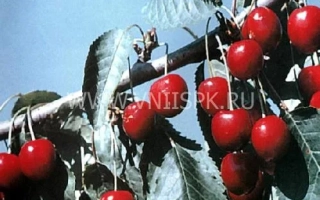
Fruit medium weight 4.7 g, maximum 7.1 g, height 21 mm, width 20 mm, thickness 19 mm, broadly heart-shaped, apex rounded, base flat, fruit, flesh and juice dark red, flesh dense, pedicel medium length and thickness. Pit oval, mass 0.31 g, 6.6% of fruit mass, brown, apex slightly pointed, base rounded, separates well from flesh. Fruits attractive, juicy, sweet, taste 4.7 points, dry detachment. Contains 17.8% dry matter, 11.7% sugars, 0.24% acids, 15.6 mg/100g ascorbic acid.
Flowering and ripening are late. Begins fruiting at age 5. Self-sterile. Best pollinators: Tyutchevka, Veda, Iput. Average yield 93 centners/ha, maximum 308 centners/ha. After severe winters, tree frost damage was 0.7 points, buds 29%, stigmas 76% at 3-5°C frost during flowering. High resistance to coccomyces, moderate to clasterosporiosis and moniliosis.
Advantages of the variety: very high potential productivity, winter hardiness, good fruit quality.
Video · 7 videos
Suggest a video →Crop & resistance
Crop
Disease resistance
Specifications
| Type of Sort | |
|---|---|
| Catalog | Catalog → Cherry, Sour Cherry |
Not yet комментариев. Be the first!
Alternatives
Cherry saplings · similar varieties


See also
Often considered together with this variety




Recently viewed
Products you’ve viewed on this site
Reviews · 0