


SKU #3653
·
300 views
Pear Cosmic
Pear
Prices in stores
No offers yet — stores have not added prices for this product yet.
Similar varieties with prices
-
Avgustovskaya rosa
from 2.67 €
-
 Bere Ziffar (Ziffar)
from 2.08 €per seedling
Bere Ziffar (Ziffar)
from 2.08 €per seedling
-
 Early Dubovskaya
from 3.68 €per seedling
Early Dubovskaya
from 3.68 €per seedling
-
 Cathedral
from 3.2 €
Cathedral
from 3.2 €
Type of Variety
Summer variety of pear
Your mark
0 votes
0% positive ratings
Description
Summer variety, obtained at the VNIIS named after I.V. Michurin by crossing the varieties 'Daughter of Blanckova' and 'Russian Malgorzhatka'. Authors: G.A. Lobanov and Z.I. Ivanova. Approved and widely grown in amateur gardens of the Central Chernozem and Non-Chernozem zones. Worthy of cultivation in commercial orchards as a cold-resistant and high-yielding variety.
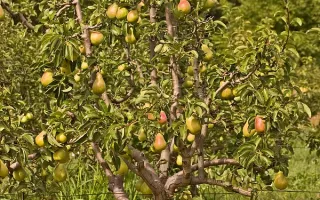
Tree is vigorous, with a rounded or wide-pyramidal, dense crown. Main branches branch off the trunk at nearly right angles.
Shoots are straight, medium thickness, brownish, with rare small lenticels. Fruit set is primarily on multi-year fruiting wood. Leaves are green, medium size, egg-shaped, with slightly uplifted margins, sometimes slightly uplifted and pointed leaf tips. Leaf blade surface is smooth and glossy.
Fruits are below average size, weighing 90-110 g, one-dimensional, cube-shaped. Skin is strong, greenish-yellow, with dark green subcutaneous spots and a slight diffuse blush on the sun-exposed side. Peduncle is thick or medium thickness, long, straight or slightly curved, upright or oblique, thickened at the base. Calyx is small, wide, ribbed. Receptacle is wide, medium depth, large-ribbed. Calyx cup is closed. Seed cavity is medium-sized. Around the seed cavity, there is a layer of gritty cells. Seed chambers are closed. Seeds are medium size, dark brown, well-formed, elongated and pointed.
Flesh is white, finely textured, sweet, good taste. Fruits contain 8.9% sugars, 0.16% acids, sugar-to-acid ratio of 56, 5.9 mg/100g ascorbic acid, 46 mg/100g P-active substances.
Fruits ripen at the end of August. Fruit quality is high, especially from young trees.
Fruits are transportable. Consumer maturity coincides with harvest. Shelf life is no more than two weeks.
Fruits are intended for fresh consumption, but suitable for processing: compotes, jams, dried fruits, etc.
Fruit production begins at 5-6 years after planting in the garden. Young trees bear fruit annually; with age, fruiting becomes periodic. High-yielding variety. In some years, yield reaches up to 150 kg per tree. Under heavy fruit load, fruit size decreases.
In Michurinsk, the variety is highly cold-resistant; in Orel, during winter 1978/79, wood freezing and bark scorching were recorded at no more than 2.5 points.
Advantages of the variety: high yield and cold resistance of the tree; fruit resistance to scab.
Disadvantages of the variety: tall, large-sized tree, periodic fruiting, reduction in fruit size under heavy fruit load, short shelf life for fresh consumption, presence of gritty cells around the seed cavity.
Video · 1 video
Suggest a video →Crop & resistance
Crop
Disease resistance
Specifications
| Type of Variety | |
|---|---|
| Catalog | Catalog → Pear |
No reviews yet. Be the first to share your experience.
Alternatives
Pear saplings · similar varieties


See also
Often considered together with this variety






Recently viewed
Products you’ve viewed on this site
Reviews