


SKU #3734
·
680 views
Pear Svarog
Pear
User rating
1 vote100% positive reviews
No ratings yet — be the first.
Type of Sort
Autumn variety of pear
Prices in stores
from3.34 €per seedling
pack from 6.45 € per pack
13 offers from 3 stores
Store offers · 13 from 3 stores
Prices are updated on loadLoading offers…
Available at: Сад от А до Я · Экоферма22 · Agromir
Aggregator catalog: prices are collected automatically from store websites, normalized by AI and converted at the current exchange rate. Before ordering, confirm the price and availability on the store's website. This block is not indexed by search engines — the data is loaded after the page opens.
About product

Early autumn variety obtained at the Scientific Research Institute of Horticulture of Siberia named after M. A. Lisavenko from crossing Chinese pear with Ber Bosc. Breeders: I. P. Kalinina, I. A. Puchkin, G. N. Baykova. Approved for Western Siberian, Eastern Siberian, and Volga-Vyatka regions.
Medium-sized tree with a round, dense crown. Bark on main branches is gray-brown, peeling.
Sho…
Type of Sort
Autumn variety of pear
Description
Early autumn variety obtained at the Scientific Research Institute of Horticulture of Siberia named after M. A. Lisavenko from crossing Chinese pear with Ber Bosc. Breeders: I. P. Kalinina, I. A. Puchkin, G. N. Baykova. Approved for Western Siberian, Eastern Siberian, and Volga-Vyatka regions.
Medium-sized tree with a round, dense crown. Bark on main branches is gray-brown, peeling.
Shoots slightly arched, dark reddish-brown, hairy at tips. Leaves small, elliptical, with spirally twisted tips, light green, wrinkled, slightly hairy.
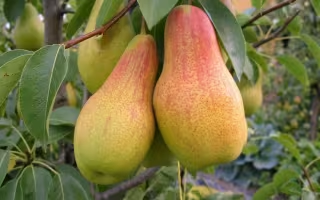
Fruits below average size (mass 78 g), obtuse-conical or broad pear-shaped. Skin not rough, dull. Main color at harvest is greenish, turning yellow at consumption stage; russeting is diffuse and striped, red, with slight blush. Under-skin spots small, greenish, clearly visible. Fruit stalk medium length, curved. Pit small, calyx persistent, dish medium depth, broad. Seed cavity small, egg-shaped. Chambers closed, medium size. Sub-calyx tube weakly expressed. Seeds large, egg-shaped, brown.
Flesh creamy, tender, semi-oily, juicy, tart-sweet, good taste. Chemical composition of fruits: total sugars — 9.5%, titratable acids — 0.44%, tannins 170 mg/100g, ascorbic acid — 9.5 mg/100g, P-active compounds — 125 mg/100g.
Harvest ripeness occurs at end of September; consumer ripeness — at beginning of October. Under room conditions, fruits keep 15-20 days; in refrigerator — until New Year. Suitable for fresh consumption and technical processing. On poor, insufficiently moist soils, fruit taste deteriorates sharply.
Enters fruiting on the fourth to fifth year. Bears fruit regularly but moderately. Moderate winter hardiness. Highly resistant to fungal diseases.
Advantages of the variety: good commercial and consumer qualities of fruits.
Disadvantages of the variety: demanding growing conditions, dense crown.
Video · 1 video
Suggest a video →Crop & resistance
Crop
Disease resistance
Specifications
| Type of Sort | |
|---|---|
| Catalog | Catalog → Pear |
Not yet комментариев. Be the first!
Alternatives
Pear saplings · similar varieties




See also
Often considered together with this variety



Recently viewed
Products you’ve viewed on this site
Reviews · 0