


SKU #3661
·
440 views
Kupava
Pear
User rating
0 votes0% positive reviews
No ratings yet — be the first.
Type of Sort
Autumn variety of pear
Prices in stores
from3.34 €per seedling
pack from 6.45 € per pack
14 offers from 4 stores
Store offers · 14 from 4 stores
Prices are updated on loadLoading offers…
Available at: Agroopt · Сад Абраменко · Лучший Сад · Agromir
Aggregator catalog: prices are collected automatically from store websites, normalized by AI and converted at the current exchange rate. Before ordering, confirm the price and availability on the store's website. This block is not indexed by search engines — the data is loaded after the page opens.
About product

Early autumn variety obtained at the Scientific Research Institute of Horticulture of Siberia named after M. A. Lisavenko from pollination of the 'Tema' variety by 'Lyubimitsa Klappa'. Breeders: I. A. Puchkin, I. P. Kalinina, E. P. Karataeva, M. I. Borisenko. Approved for the West Siberian region. Medium-sized tree with a round, rather dense crown. Shoots are thin, straight, yellow-brown. L…
Type of Sort
Autumn variety of pear
Description
Early autumn variety obtained at the Scientific Research Institute of Horticulture of Siberia named after M. A. Lisavenko from pollination of the 'Tema' variety by 'Lyubimitsa Klappa'. Breeders: I. A. Puchkin, I. P. Kalinina, E. P. Karataeva, M. I. Borisenko. Approved for the West Siberian region.
Medium-sized tree with a round, rather dense crown.
Shoots are thin, straight, yellow-brown. Leaves are medium-sized, round, green, smooth, on thin long petioles. Predominant type of fruiting structures — simple and compound rings. Characteristic feature of fruiting — abundance of fruits on some branches and complete absence on neighboring ones.
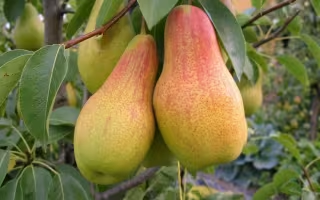
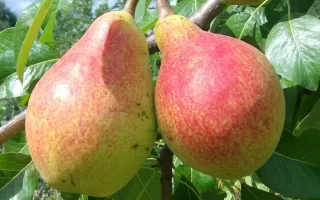
Fruits are below average size (mass 88 g), pear-shaped, slightly tapered, strongly warty, with a sharp taper to the apex. Skin is not rough, oily, shiny. Main color is golden-yellow, covering — bright red blush occupying up to one-third of the fruit surface. Subcutaneous dots are few, small, green, barely noticeable. Peduncle is long, curved, oblique. Pit is not pronounced. Calyx is non-dehiscent, half-open. Subcalyx tube is weakly expressed. Dish is wide, ridged. Heart is medium-sized, onion-shaped. Seed chambers are closed. Seeds are egg-shaped, brown.
Flesh is white, firm, juicy, medium-textured, slightly acidic-sweet, quite good taste. Chemical composition of fruits: total sugar — 11.5%, titratable acids — 0.32%, tannins — 104 mg/100g, ascorbic acid — 11.0 mg/100g, P-active substances — 120 mg/100g.
Fruits ripen in mid-September and can be stored for up to two weeks, in a refrigerator — up to two months. Suitable for fresh consumption and production of high-quality compotes.
Begins fruiting on the 4th-5th year. Yield is moderate, regular.
Cold resistance of Kupava is satisfactory, slightly lower than older Siberian lukašovka varieties. Highly resistant to fungal diseases.
Advantages of the variety: good commercial and consumer qualities of fruits, high resistance to fungal diseases.
Disadvantages of the variety: insufficiently high cold resistance, susceptibility to damage by the pear fruit moth.
Video · 1 video
Suggest a video →Crop & resistance
Crop
Disease resistance
Specifications
| Type of Sort | |
|---|---|
| Catalog | Catalog → Pear |
Not yet комментариев. Be the first!
Alternatives
Pear saplings · similar varieties






See also
Often considered together with this variety




Recently viewed
Products you’ve viewed on this site
Reviews · 0