


SKU #68608
·
53 views
Alfalfa Selyanka
Lucerne
Prices in stores
No offers yet — stores have not added prices for this product yet.
Similar varieties with prices
-
 ASHEN KATY
from 1.81 €per 1 kg
ASHEN KATY
from 1.81 €per 1 kg
-
 PlatoFeldsaaten Freudenberger GmbH&Co.KG
from 20.44 €per 1 kg
PlatoFeldsaaten Freudenberger GmbH&Co.KG
from 20.44 €per 1 kg
-
 Banat VSIFVCNS (Novi Sad)
from 3.84 €per 1 kg
Banat VSIFVCNS (Novi Sad)
from 3.84 €per 1 kg
-
 Ramina
from 6.54 €за л
Ramina
from 6.54 €за л
Plant Height
95-110
Registration year
2013
Your mark
0 votes
0% positive ratings
Description
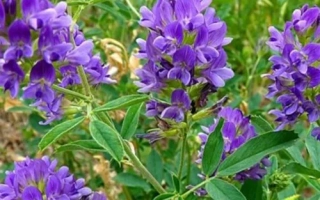
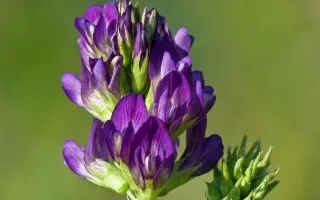
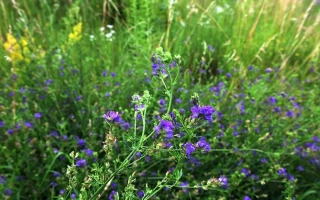
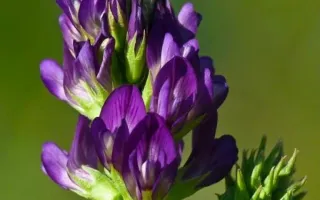
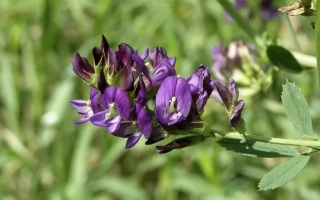
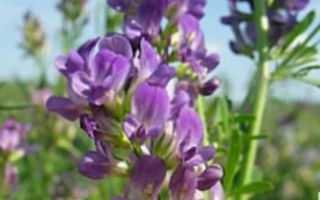
The Selyanka lucerne variety represents an artificial hybrid population created through hybridization, selection, and polycross methods. The plants are characterized by a semi-prostrate, sprawling, semi-erect rosette, reaching 95-110 cm in height at the beginning of flowering. Stems are rounded, of medium coarseness, and leaflets are large, inversely egg-shaped, dark green in color, without a waxy coating and with sparse hairiness. Plant foliage constitutes 48-52%, while flower petal coloring is diverse: about 50% purple, 40-45% blue, and 5-10% pale blue shades. The variety belongs to the blue-hybrid lucerne group and is distinguished by medium spring height, a semi-erect bush, and a light green leaf color. The central leaflet has medium length and width. During full flowering, stems are of medium length, and after mowing, plant height varies from low to medium. Dry matter yield in various regions fluctuates: in the North Caucasus region, it averages 63.3 c/ha, which is above the standard average, with a maximum figure of 123.7 c/ha, while in the Lower Volga region, yield is about 19.4 c/ha, matching the average level. The Selyanka variety exhibits good resistance to diseases and climatic conditions, making it suitable for cultivation in the North Caucasus, Lower Volga, and Urals regions. Feed quality is high: crude protein content reaches 20.2%, crude fiber — 30%, and dry matter — 28.5%. Green mass yield is about 3.6 t/ha, dry matter — 0.75 t/ha, and seeds — 0.03 t/ha. The variety belongs to the early-maturing group and is released as elite seeds, ensuring high productivity and quality when used in feed production.
Crop & resistance
Crop
Specifications
| Plant Height | 95-110 |
|---|---|
| Registration year | 2013 |
| Catalog | Catalog → Lucerne |
| Legal data |
Show · 1
|
| Country | Russia |
No reviews yet. Be the first to share your experience.
Alternatives
Alfalfa seeds · similar varieties


See also
Often considered together with this variety




Recently viewed
Products you’ve viewed on this site
Reviews