


Prices in stores
No offers yet — stores have not added prices for this product yet.
Similar varieties with prices
-
 ASHEN KATY
from 1.81 €per 1 kg
ASHEN KATY
from 1.81 €per 1 kg
-
 PlatoFeldsaaten Freudenberger GmbH&Co.KG
from 20.44 €per 1 kg
PlatoFeldsaaten Freudenberger GmbH&Co.KG
from 20.44 €per 1 kg
-
 Banat VSIFVCNS (Novi Sad)
from 3.84 €per 1 kg
Banat VSIFVCNS (Novi Sad)
from 3.84 €per 1 kg
-
 Ramina
from 6.54 €за л
Ramina
from 6.54 €за л
Plant Height
110-120
Registration year
1995
Your mark
0 votes
0% positive ratings
Description
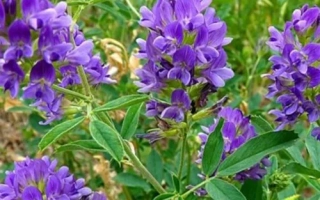
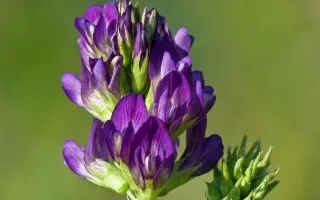
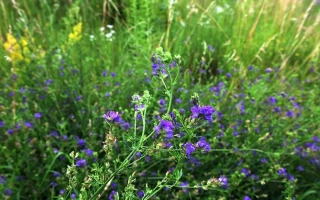
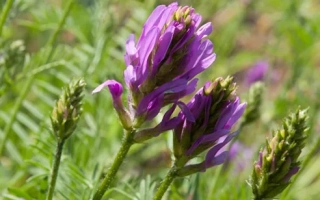
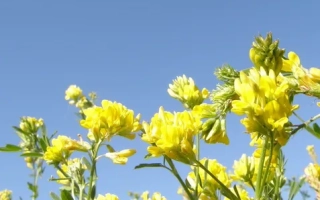
Kevsala is a variety of blue alfalfa (Medicago sativa L. subsp. sativa) bred by mass selection from a hybrid population obtained by crossing wild local alfalfas with the Slavyanskaya local variety. The plant is characterized by a bush ranging from semi-erect to sprawling form, sparsely hairy stems of medium coarseness 110 to 120 cm long, and low bushiness reaching up to 32 stems. Leaflets are obvert oval in shape, soft, dark green in color with very weak hairiness; stipules are triangular-lanceolate with anthocyan veins. Inflorescences are represented by cylindrical racemes of medium length with corolla colors ranging from violet to light blue. Pods are spiral with 2.5–4 turns, seeds are kidney-shaped yellow-green in color, the mass of 1000 seeds is 1.9–2.0 g.
The Kevsala variety belongs to medium-early maturing types, with a vegetative period from the beginning of regrowth to the first cut of 66–81 days and to commercial seed ripeness of 115–154 days. In terms of protein content, it meets the standard, which makes it valuable for fodder use. Yield of dry matter varies in different regions: in the Central Black Earth region, the average yield is 84.0 c/ha, in the North Caucasus — 91.3 c/ha, and in the Middle Volga — 73.4 c/ha. Maximum dry matter yield indicators were achieved in the Voronezh region (152.8 c/ha) and Krasnodar Krai (114 c/ha).
Due to its agronomic characteristics and stable yield, the Kevsala variety is widely used in fodder production. It is suitable for cultivation in various climatic conditions, providing high-quality raw material with optimal protein content. This alfalfa variety is a reliable choice for farmers seeking to obtain a sustainable and productive fodder resource.
The Kevsala variety belongs to medium-early maturing types, with a vegetative period from the beginning of regrowth to the first cut of 66–81 days and to commercial seed ripeness of 115–154 days. In terms of protein content, it meets the standard, which makes it valuable for fodder use. Yield of dry matter varies in different regions: in the Central Black Earth region, the average yield is 84.0 c/ha, in the North Caucasus — 91.3 c/ha, and in the Middle Volga — 73.4 c/ha. Maximum dry matter yield indicators were achieved in the Voronezh region (152.8 c/ha) and Krasnodar Krai (114 c/ha).
Due to its agronomic characteristics and stable yield, the Kevsala variety is widely used in fodder production. It is suitable for cultivation in various climatic conditions, providing high-quality raw material with optimal protein content. This alfalfa variety is a reliable choice for farmers seeking to obtain a sustainable and productive fodder resource.
Crop & resistance
Crop
Specifications
| Plant Height | 110-120 |
|---|---|
| Registration year | 1995 |
| Catalog | Catalog → Lucerne |
| Manufacturer | North Caucasian FARC |
| Legal data |
Show · 5
|
| Country | Russia |
No reviews yet. Be the first to share your experience.
Alternatives
Alfalfa seeds · similar varieties


See also
Often considered together with this variety


Recently viewed
Products you’ve viewed on this site
Reviews