


Prices in stores
from5.81 €per 1 kg
pack from 5.81 € per 1 kg
1 offer from 1 store
Plant Height
70-90
Registration year
2017
Your mark
0 votes
0% positive ratings
Store offers · 1 from 1 store
1 offer in 1 store — from 5.81 € per 1 kg.
Available at: Udachniy
Prices are collected automatically from store websites and converted at the current exchange rate. Check the price and availability on the store website before ordering.
Description
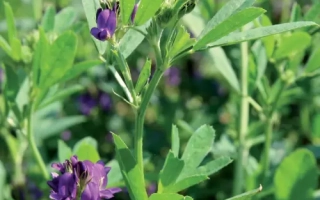
The 'Elena' variety of alfalfa (Medicago sativa L. subsp. sativa) is a mid-early variety with an upright or semi-upright medium-height bush. The leaves have a medium-intensity dark green color, while the flowers are predominantly blue-violet, giving the plant its characteristic appearance. The variety is characterized by rapid regrowth in spring and after cuts, which contributes to high yields of fodder mass and seeds. The average dry matter yield in the Central Black Earth region reaches 86.6 c/ha, which is 9.5 c/ha higher than the average standard, while the maximum yield can reach 176.9 c/ha. Despite this, the variety is inferior to the standard in protein content and collection.
Alfalfa 'Elena' is widely used as a fodder crop for animals, suitable for sowing on all types of pastures and used for summer grazing, as well as for silage preparation and grass meal production, which is added to concentrated feeds. The plant is frost-hardy, disease-resistant, and not prone to lodging, ensuring its reliability and longevity under various climatic conditions. Thanks to its drought resistance and ability to grow well on heavy clay soils, alfalfa does not require frequent irrigation, which facilitates its cultivation.
In addition to fodder properties, 'Elena' variety alfalfa is used as a green manure fertilizer, contributing to soil acidity reduction and humus accumulation. It is a good predecessor for many garden crops, except legumes such as peas and beans. The plant loves moisture but also withstands drought well, making it versatile and useful for various agricultural systems. Sowing of seeds is carried out in April, seedlings appear within two weeks, and active growth continues until winter, while alfalfa is capable of overwintering in the ground without additional cover.
Alfalfa 'Elena' is widely used as a fodder crop for animals, suitable for sowing on all types of pastures and used for summer grazing, as well as for silage preparation and grass meal production, which is added to concentrated feeds. The plant is frost-hardy, disease-resistant, and not prone to lodging, ensuring its reliability and longevity under various climatic conditions. Thanks to its drought resistance and ability to grow well on heavy clay soils, alfalfa does not require frequent irrigation, which facilitates its cultivation.
In addition to fodder properties, 'Elena' variety alfalfa is used as a green manure fertilizer, contributing to soil acidity reduction and humus accumulation. It is a good predecessor for many garden crops, except legumes such as peas and beans. The plant loves moisture but also withstands drought well, making it versatile and useful for various agricultural systems. Sowing of seeds is carried out in April, seedlings appear within two weeks, and active growth continues until winter, while alfalfa is capable of overwintering in the ground without additional cover.
Crop & resistance
Crop
Disease resistance
Specifications
| Plant Height | 70-90 |
|---|---|
| Registration year | 2017 |
| Catalog | Catalog → Lucerne |
| Manufacturer | North Caucasian FARC |
| Legal data |
Show · 8
|
| Country | Russia |
No reviews yet. Be the first to share your experience.
Alternatives
Alfalfa seeds · similar varieties




See also
Often considered together with this variety


Recently viewed
Products you’ve viewed on this site
Reviews