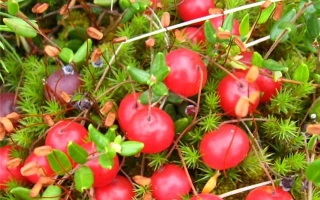
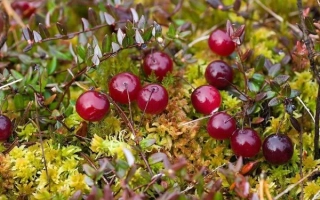
Lowbush Cranberry «Alaya Zapovednaya» – a variety selected from wild-growing forms in the Vologda region and developed by the Kostroma Forest Experimental Station. Berries are large (average mass 0.8–2.2 g), spherical, juicy and sour, with no noticeable aroma. Their chemical composition is characterized by a sugar content of about 7.3% and acids – 2.9%, as well as a high level of vitamin C (≈23%).
The plant's shape features a sparsely growing bush with creeping shoots. Shoots are thin, brown, matte, and thornless; leaves are small, green, smooth, and leathery, egg-shaped-lanceolate with edges curled downwards. Flowers are medium-sized and pale, while the ovary is bare and rounded.
«Alaya Zapovednaya» is distinguished by high frost resistance: it endures temperatures down to –33 °C under snow, making it suitable for cultivation in cold regions. The variety is resistant to snow mold (susceptibility without winter flooding: 4 points, with flooding – 1), and pest damage has not been recorded. Yield is of medium size: about 75 c/ha according to data from 1990–1993 and approximately 1.2 kg per sq.m under modern conditions. The variety requires peat soils of raised or transitional bogs with an optimal groundwater level of 30 cm.
Thus, «Alaya Zapovednaya» is a reliable, frost-resistant cranberry variety with large, sour berries of high vitamin C content and good yield, suitable for cultivation in northern climatic conditions.