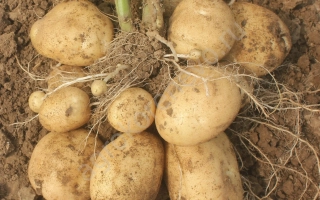
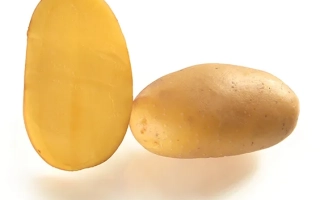
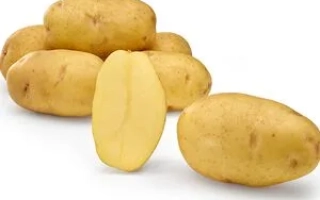
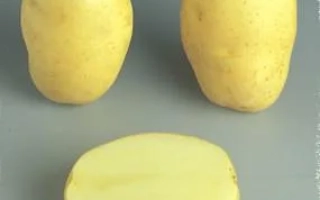
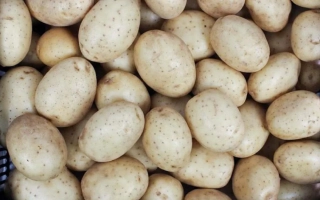
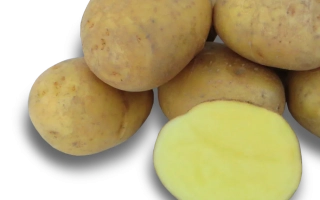
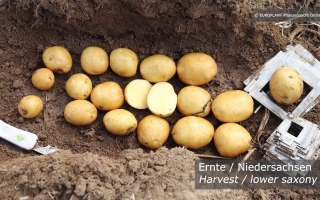
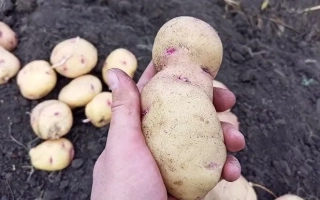
The potato variety Kalinka is a mid-early table variety with high yield and excellent taste qualities. Plants of this variety are semi-upright, tall, with dark green medium-sized leaves and a flower calyx with intense anthocyanin coloring on the inner side. Tubers are oval-shaped with small surface eyes, have red skin and light-yellow flesh. The weight of marketable tubers ranges from 92 to 166 grams, and the number of tubers per plant is 12-15. Starch content in tubers reaches 17.3%, ensuring good culinary properties and suitability for boiling, frying, baking, stuffing, as well as processing into crispy potatoes and mashed potatoes. The variety Kalinka has high marketability (85%) and excellent storability (94%), ensuring long-term storage under proper conditions. For storage, tubers should be dried immediately after placement in storage, the curing period lasts two to three weeks, and main storage is conducted at 3–4°C. Ethylene should not be applied when storing seed material. The potato is resistant to several diseases, including potato cancer, golden potato cyst nematode, striped mosaic, and leaf curling. According to phytopathological studies, the variety shows moderate susceptibility to late blight on foliage and tubers. The yield of the Kalinka variety reaches 175–506 centners per hectare, significantly exceeding the yields of standard varieties such as Elizabeth and Innovator. The maximum registered yield is 522 centners per hectare. The plant is easy to grow, resistant to major pests and diseases, making it attractive to farmers and gardeners. Culinary type BC is characterized by moderate softening, allowing tubers to be used in various dishes while preserving their shape and flavor.