Winter variety, developed at the Maikop Experimental Station of VIR by breeders A. S. Tuz and I. A. Bandurko. Parental forms: (Triumph Vienna Ch Olivier de Serre) Ch (Jervé Ch Max Red Bartlett). Currently, its cultivation is limited. Promising for cultivation in the North Caucasus and Transcaucasia.
Medium-growing or weak-growing tree: 15-year-old tree height 3.5 m, crown diameter 2.7 m. Young trees have a pyramidal crown, which becomes spreading, medium density, and foliage coverage. Good vegetative branching ability. Branches medium length, straight, depart from the trunk at nearly upright angles, droop under fruit weight. Bark on trunk and main branches smooth, gray. Fruit set mixed: on simple and complex buds and at the tips of vegetative shoots.
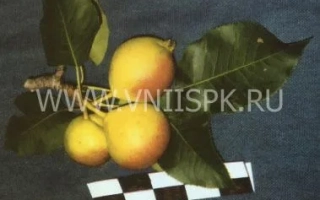
Shoots straight, bare, dark red. Stipules few, medium size. Leaves medium size, elliptical. Leaf blade flat, slightly curved upward, smooth, glossy, with coarse venation. Leaf margin entire or finely toothed. Leaf pubescence absent, color dark green with reddish tint. Leaf petiole medium length and thickness, bare, with anthocyanin. Stipules medium size, awl-shaped.
Flowers medium size, white, rose-colored in bud, small cup-shaped, fragrant. Style medium length, bare, stigma at stigma level. Flowering occurs in mid-late season, 1-2 days after Williams variety.
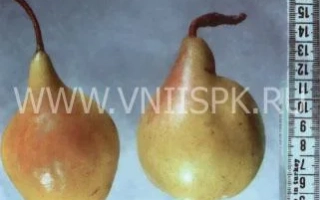
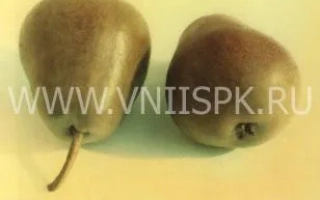
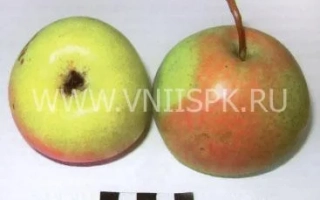
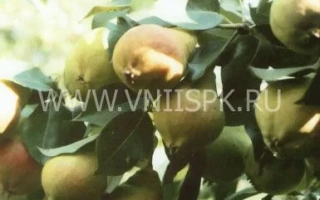
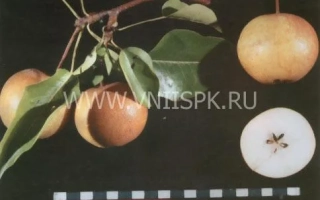
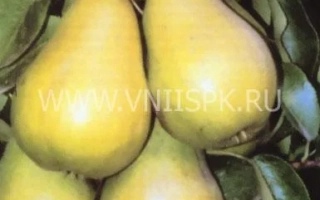
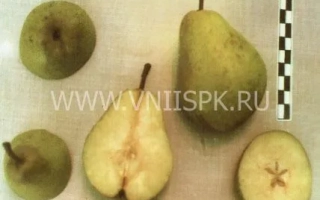
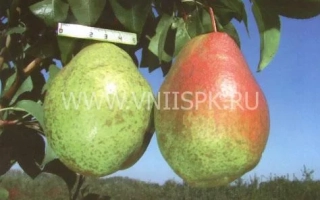
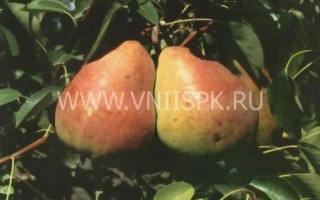
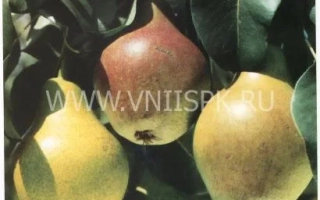
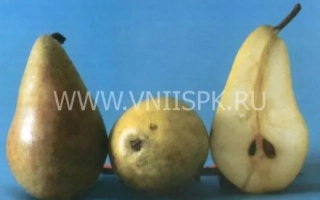
Fruits above average or large size (average fruit weight 180 g, maximum 350 g). Fruit shape pear-shaped. Fruit skin smooth, glossy, with bloom. Main color at harvest greenish, at consumer ripeness golden-yellow, covering color dark red over entire fruit surface. Numerous, large, rust-colored lenticels, clearly visible. Peduncle medium or short length, medium thickness, straight, sometimes slightly angled, brown, woody. Calyx tube small, narrow, without rust. Calyx persistent, half-open or closed. Receptacle medium depth, narrow. Heart large, elliptical. Seed chambers closed, central cavity absent. Calyx tube medium size, cup-shaped. Seeds large, egg-shaped, dark brown.
Flesh creamy, medium density, tender, very juicy. Taste sweet-sour, slightly spicy, with mild aroma.
Fruits contain 15.2% dry matter, 9.5% sugars, 0.4% organic acids, 3.2 mg/100g ascorbic acid.
Harvesting takes place in the second half of September.
Fruits have excellent appearance and good taste, store well in basement-type storage. Consumption begins at the end of October and continues until the end of December. Fruit attachment strength and transportability are medium. Main use is fresh consumption.
Self-sterile, best pollinators: Conference, Williams, Triumph Pakgama.
Early bearing variety, trees start fruiting at 4 years and quickly increase yield. High productivity during full fruiting: 10-13-year-old trees yield 30-55 kg, which at optimal planting density (416 trees per hectare) equals 125-230 centners per hectare. Fruit set is regular, occasionally excessive, leading to branch thinning.
Easily propagated on seedling rootstocks of Caucasian and forest pear, incompatible with quince clonal and seedling rootstocks. Trees adapt well to various soil compositions with sufficient moisture.
Winter hardiness in the foothill zone of the North-Western Caucasus is medium; in February 1985, generative buds were damaged by 2 points at -25єC. Drought and heat resistance are medium, with low leaf water retention capacity.
Disease resistance is high. Maximum disease severity score for most damaging diseases (scab and brown spot) does not exceed 2 points, whereas most regionally adapted varieties are severely affected (4 points).
Advantages of the variety: early bearing, high productivity, excellent fruit appearance, resistance to fungal diseases, suitability for intensive cultivation.
Disadvantages of the variety: excessively heavy fruiting.