


SKU #62122
·
61 views
LAKHEDI MEZES
Grape
User rating
0 votes0% positive reviews
No ratings yet — be the first.
Usage Group
Technical
Ripening Period
Early, Medium
Cold Resistance
High (up to -24°C)
Resistance to Mildew
High
Store offers · 1 from 1 stores
Prices are updated on loadLoading offers…
Available at: Приватний плодорозсадник Таміла
Aggregator catalog: prices are collected automatically from store websites, normalized by AI and converted at the current exchange rate. Before ordering, confirm the price and availability on the store's website. This block is not indexed by search engines — the data is loaded after the page opens.
About product

Lakhedi Mezes grape is a technical variety of Hungarian origin intended for the production of high-quality table wines. The variety is characterized by early-mid ripening with a vegetative period of 130-135 days. Bushes have medium vigor, moderate number of suckers, and well-matured canes. Leaves are small, entire or weakly lobed, with light hairiness on veins underneath. Flowers are perfect and d…
Usage Group
Technical
Ripening Period
Early, Medium
Cold Resistance
High (up to -24°C)
Resistance to Mildew
High
Description
Lakhedi Mezes grape is a technical variety of Hungarian origin intended for the production of high-quality table wines. The variety is characterized by early-mid ripening with a vegetative period of 130-135 days. Bushes have medium vigor, moderate number of suckers, and well-matured canes. Leaves are small, entire or weakly lobed, with light hairiness on veins underneath. Flowers are perfect and do not require pollinators.
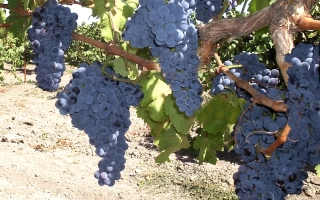
Clusters of Lakhedi Mezes are medium-sized, cylindro-conical, dense, weighing about 230 grams. Berries are medium-sized, round, white with a slight tan on the sun-exposed side, acquiring an amber hue upon overripening. The flesh is juicy, with a harmonious taste, lacking a pronounced varietal aroma, resembling Riesling. The variety has high sugar accumulation — at harvest, sugar content is 23-25%, with acidity of 6-8 g/l.
Lakhedi Mezes is distinguished by high yield — up to 160 c/ha, however, it is prone to overloading, thus requiring normalization. The variety is resistant to downy and powdery mildew; however, for fungal disease prevention, two treatments per season are sufficient. It is not resistant to grey rot. Frost resistance is enhanced — it withstands temperature drops to -23…-26 °C. It is not resistant to phylloxera, so it is grown on rootstocks. Wines from this variety are characterized by a rich, typically grape flavor without pronounced specific off-flavors.
Clusters of Lakhedi Mezes are medium-sized, cylindro-conical, dense, weighing about 230 grams. Berries are medium-sized, round, white with a slight tan on the sun-exposed side, acquiring an amber hue upon overripening. The flesh is juicy, with a harmonious taste, lacking a pronounced varietal aroma, resembling Riesling. The variety has high sugar accumulation — at harvest, sugar content is 23-25%, with acidity of 6-8 g/l.
Lakhedi Mezes is distinguished by high yield — up to 160 c/ha, however, it is prone to overloading, thus requiring normalization. The variety is resistant to downy and powdery mildew; however, for fungal disease prevention, two treatments per season are sufficient. It is not resistant to grey rot. Frost resistance is enhanced — it withstands temperature drops to -23…-26 °C. It is not resistant to phylloxera, so it is grown on rootstocks. Wines from this variety are characterized by a rich, typically grape flavor without pronounced specific off-flavors.
Crop & resistance
Crop
Disease resistance
Specifications hover over for a hint about the specification
| Usage Group | |
|---|---|
|
Ripening Period
Ripening Period
It takes 70-100 days until pepper reaches flowering stage, 130-160 days until technical fruit ripeness, and 135-180 days until physiological ripeness. |
Early, Medium |
| Cold Resistance | |
| Resistance to Mildew | |
| Resistance to oidium | |
| Resistance to Gray Mold | |
|
Yield
Yield
Overall bulb harvest per unit area. Depends on both onion variety characteristics and agronomic practices, fertilizers, and irrigation. Under optimal growing conditions, an onion yield of 100 tons per hectare and above is not considered record-breaking. |
High |
| Bush Growth Power | |
| Flower Type | |
| Bunch Size | Medium (300–500 g) |
| Berry Size | Medium (2–5 g) |
| Berry Color | |
| Flavor | |
| Sugar Content | High (>20%) |
| Care Requirement | |
| Assignment | |
| Registration year | 1998 |
| Catalog | Catalog → Grape |
| Legal data |
Show · 7
|
| Country | Russia |
Not yet комментариев. Be the first!
Alternatives
Grapevine saplings · similar varieties


See also
Often considered together with this variety







Recently viewed
Products you’ve viewed on this site
Reviews · 0