


SKU #72826
·
71 views
GORNOLTAISKIY 87
Goat's Rue
FANCAUser rating
0 votes0% positive reviews
No ratings yet — be the first.
Assignment
Feed, Silage, For Pastures
Plant Type
Perennial
Plant Height
60-80 cm
Registration year
1992
About product

The Eastern Milkvetch variety "Gornoltaiskiy 87" is a large, erect plant, 1-1.5 m tall, with hollow, thin-walled stems and a powerful root system of the sprout type. Leaves are large, odd-pinnate, dark green, and at the ends of branches are long racemes 16–25 cm long with 20–60 large bluish flowers.The variety is distinguished by high yields: under favorable moisture conditions, green mass reaches…
Assignment
Feed, Silage, For Pastures
Plant Type
Perennial
Plant Height
60-80 cm
Registration year
1992
Description
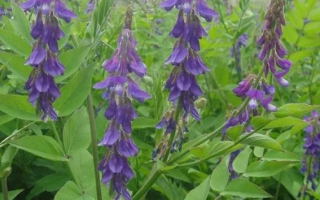
The Eastern Milkvetch variety "Gornoltaiskiy 87" is a large, erect plant, 1-1.5 m tall, with hollow, thin-walled stems and a powerful root system of the sprout type. Leaves are large, odd-pinnate, dark green, and at the ends of branches are long racemes 16–25 cm long with 20–60 large bluish flowers.
The variety is distinguished by high yields: under favorable moisture conditions, green mass reaches 30-40 t/hectare, dry matter – 6-8 t/hectare, and seeds – 0.2-0.3 t/hectare. Pods are linear, saber-shaped, 3-5 cm long, containing 3 to 12 seeds. Seeds are large, bud-shaped, fresh ones have a yellowish-green or olive tint, and during storage change to light brown, then dark brown color.
"Gornoltaiskiy 87" was bred by FGUNU Altai Research Institute of Agricultural Sciences by repeated mass selection from a sample of the VRII Feed named after V.R. Williams and included in the state register of breeding achievements since 1992. The plant adapts well to the conditions of Western Siberia, but shows moisture-loving properties: with an annual rainfall of less than 400 mm, yields decrease. In the first year after sowing, plant height reaches 25-30 cm (in optimal conditions – 60-70 cm), and during 43-70 days from the beginning of growth to the first cut and 91-146 days to seed harvest maturity.
Eastern Milkvetch is characterized by good palatability of green mass, medium silageability and low alkaloid galegine content compared to other milkvetch species. This makes it a valuable feed material for livestock in regions with moderately cold climatic conditions.
The variety is distinguished by high yields: under favorable moisture conditions, green mass reaches 30-40 t/hectare, dry matter – 6-8 t/hectare, and seeds – 0.2-0.3 t/hectare. Pods are linear, saber-shaped, 3-5 cm long, containing 3 to 12 seeds. Seeds are large, bud-shaped, fresh ones have a yellowish-green or olive tint, and during storage change to light brown, then dark brown color.
"Gornoltaiskiy 87" was bred by FGUNU Altai Research Institute of Agricultural Sciences by repeated mass selection from a sample of the VRII Feed named after V.R. Williams and included in the state register of breeding achievements since 1992. The plant adapts well to the conditions of Western Siberia, but shows moisture-loving properties: with an annual rainfall of less than 400 mm, yields decrease. In the first year after sowing, plant height reaches 25-30 cm (in optimal conditions – 60-70 cm), and during 43-70 days from the beginning of growth to the first cut and 91-146 days to seed harvest maturity.
Eastern Milkvetch is characterized by good palatability of green mass, medium silageability and low alkaloid galegine content compared to other milkvetch species. This makes it a valuable feed material for livestock in regions with moderately cold climatic conditions.
Crop & resistance
Crop
Specifications
| Assignment | |
|---|---|
| Plant Type | |
| Plant Height | 60-80 cm |
| Registration year | 1992 |
| Catalog | Catalog → Goat's Rue |
| Manufacturer | FANCA |
| Legal data |
Show · 1
|
| Country | Russia |
Store offers
Prices are updated on loadLoading offers…
Aggregator catalog: prices are collected automatically from store websites, normalized by AI and converted at the current exchange rate. Before ordering, confirm the price and availability on the store's website. This block is not indexed by search engines — the data is loaded after the page opens.
Not yet комментариев. Be the first!
Alternatives
Goat's Rue · similar varieties




See also
Often considered together with this variety


Recently viewed
Products you’ve viewed on this site
Reviews · 0