
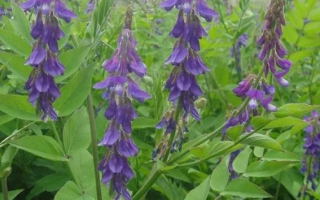


SKU #72823
·
63 views
Galega
Goat's Rue
User rating
0 votes0% positive reviews
No ratings yet — be the first.
Assignment
Feed
Plant Type
Bean Plant
Green Mass Yield (t/ha)
40-50 t/ha
Registration year
1988
Prices in stores
from0.39 €per 1 kg
pack from 0.19 € per 500 g
1 offer from 1 store
Store offers · 1 from 1 stores
Prices are updated on loadLoading offers…
Available at: Gazonov
Aggregator catalog: prices are collected automatically from store websites, normalized by AI and converted at the current exchange rate. Before ordering, confirm the price and availability on the store's website. This block is not indexed by search engines — the data is loaded after the page opens.
About product

A perennial legume for high-yield, long-term forage production with an average yield of 40-50 t/ha.
Assignment
Feed
Plant Type
Bean Plant
Green Mass Yield (t/ha)
40-50 t/ha
Registration year
1988
Description
A sustainable protein source for long-term forage production
The «Gale» goat's rue (Galega orientalis) is a strategic choice for agricultural enterprises aiming to secure a stable forage supply for up to a decade. Unlike annual forage crops that require constant soil disturbance, Gale stands out as a long-term perennial, maintaining high productivity levels of 40–50 t/ha of green mass for many years.
Field operations and practical application
- Rotation Benefits: Gale is an excellent soil improver. Its extensive root system fixes nitrogen, significantly increasing soil fertility for subsequent crops in the rotation cycle.
- Early Season Advantage: One of the key operational advantages of this variety is its early spring growth. It starts vegetating as soon as the snow melts, providing essential early-season protein when other grasses are still dormant.
- Simplified Weed Management: Once established, the dense stand of Gale effectively suppresses weeds, which reduces the need for chemical weed control measures and lowers operational costs.
For farm managers, Gale is synonymous with reliability. Its winter hardiness and drought tolerance make it suitable for diverse climatic zones where more demanding legumes might fail. By harvesting during the budding stage, producers maximize protein content, turning this crop into a high-efficiency component of any livestock ration.
Video · 1 video
Suggest a video →Crop & resistance
Crop
Specifications
Not yet комментариев. Be the first!
Alternatives
Goat's Rue · similar varieties


See also
Often considered together with this variety


Recently viewed
Products you’ve viewed on this site
Reviews · 0