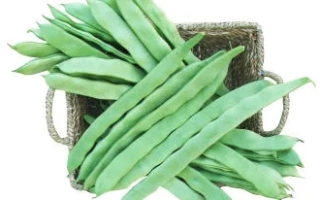
The SOBRAT bean variety is a mid-early bush plant standing 50–55 cm tall, characterized by high yield and excellent fruit quality. The period from germination to technical bean maturity is 50–52 days, and to full seed ripening — 72–76 days. The beans are straight or slightly curved, smooth, heart-shaped in cross-section, green in color without a parchment layer and without seam fibers. Their length reaches 10–11 cm, width is 0.7–0.8 cm, and the lower beans are positioned 11–12 cm above the soil surface. The mass of 100 beans is 390–400 g, indicating good density and harvest weight. SOBRAT beans possess high nutritional qualities: dry matter content in beans varies from 9.97% to 10.12%, sugars — 1.83–1.99%, starch — 3.21–3.37%, ascorbic acid — 11.49–13.64%, protein — 2.13–2.27%, and fiber — 1.0–1.12%. Seeds are white, small, shiny, and elliptical in shape; the mass of 1000 seeds is 194–197 g. The variety demonstrates relative resistance to bacterial blight, enhancing its reliability during cultivation. Yield reaches 13.3–14.6 tons per hectare, making SOBRAT beans attractive for home use and industrial processing, including canning and freezing. Moreover, like other legumes, beans play a crucial role in improving soil quality. Nitrogen-fixing bacteria inhabit bean roots, binding atmospheric nitrogen and converting it into a plant-available form, thereby enriching the soil and increasing its fertility. Additionally, legumes possess insecticidal properties, repelling pests and protecting crops. Thanks to these features, SOBRAT beans not only provide a tasty and nutritious harvest but also contribute to maintaining garden soil health.