


SKU #74563
·
56 views
Kirovohradskyi 27
Sainfoin
User rating
0 votes0% positive reviews
No ratings yet — be the first.
Usage Type
On feed, Honeybee
Registration year
1994
Prices in stores
from1.52 €per 1 kg
pack from 1.52 € per 1 kg
2 offers from 2 stores
Store offers · 2 from 2 stores
Prices are updated on loadLoading offers…
Available at: Агроексперт-Трейд · pchelosad.com.ua · Насіння-UA
Aggregator catalog: prices are collected automatically from store websites, normalized by AI and converted at the current exchange rate. Before ordering, confirm the price and availability on the store's website. This block is not indexed by search engines — the data is loaded after the page opens.
About product

Esparcet "Kirovohradskyi 27" – one of the recommended varieties of a perennial forage crop grown in the steppe zone of Ukraine. The variety was developed at the Kirovohrad State Agricultural Experimental Station ISGSZ of NAS of Ukraine and is characterized by high yield and resistance to adverse environmental conditions.Esparcet blood is rich in nutrients: in 100 kg of green mass, there are about…
Usage Type
On feed, Honeybee
Registration year
1994
Description
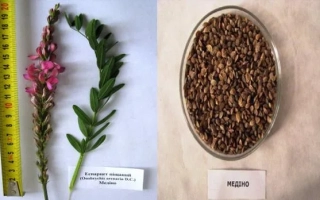
Esparcet "Kirovohradskyi 27" – one of the recommended varieties of a perennial forage crop grown in the steppe zone of Ukraine. The variety was developed at the Kirovohrad State Agricultural Experimental Station ISGSZ of NAS of Ukraine and is characterized by high yield and resistance to adverse environmental conditions.
Esparcet blood is rich in nutrients: in 100 kg of green mass, there are about 17.3 kg of feed units, and digestible protein – 2.8 kg. Hay of this crop has a high digestion coefficient and contains up to 60 g of sugar per kilogram of dry matter, which increases energy supply for animals. Dry matter of hay also contains vitamin C in an amount of up to 228 mg/kg, which contributes to strengthening immunity.
The variety "Kirovohradskyi 27" is sown using three main methods: early spring under cover of early grain crops, early spring non-cover, and summer non-cover. When sown under cover of barley, it is recommended to reduce the sowing rate of the cover crop by 15–20% and to remove barley in time. Summer sowing is carried out in the second half of June–July, but no later than August 1–5. Effective weed control is achieved when sowing on fallow land, and for field treatment, chain harrows are used.
Esparcet "Kirovohradskyi 27" is also valued as a honey-producing plant, providing high-quality honey and hay, which is considered one of the best feeds for all types of livestock. Due to the combination of high nutritional value, resistance to stressful conditions, and the possibility of use in various agro-technical schemes, this variety is the preferred choice for farmers seeking to increase the productivity of their pastures and improve animal rations.
Esparcet blood is rich in nutrients: in 100 kg of green mass, there are about 17.3 kg of feed units, and digestible protein – 2.8 kg. Hay of this crop has a high digestion coefficient and contains up to 60 g of sugar per kilogram of dry matter, which increases energy supply for animals. Dry matter of hay also contains vitamin C in an amount of up to 228 mg/kg, which contributes to strengthening immunity.
The variety "Kirovohradskyi 27" is sown using three main methods: early spring under cover of early grain crops, early spring non-cover, and summer non-cover. When sown under cover of barley, it is recommended to reduce the sowing rate of the cover crop by 15–20% and to remove barley in time. Summer sowing is carried out in the second half of June–July, but no later than August 1–5. Effective weed control is achieved when sowing on fallow land, and for field treatment, chain harrows are used.
Esparcet "Kirovohradskyi 27" is also valued as a honey-producing plant, providing high-quality honey and hay, which is considered one of the best feeds for all types of livestock. Due to the combination of high nutritional value, resistance to stressful conditions, and the possibility of use in various agro-technical schemes, this variety is the preferred choice for farmers seeking to increase the productivity of their pastures and improve animal rations.
Crop & resistance
Crop
Specifications
| Usage Type | |
|---|---|
| Registration year | 1994 |
| Catalog | Catalog → Sainfoin |
| Legal data |
Show · 1
|
| Country | Ukraine |
Not yet комментариев. Be the first!




See also
Often considered together with this variety


Recently viewed
Products you’ve viewed on this site
Reviews · 0