



SKU #72127
·
71 views
Sainfoin PETUSHOK
Sainfoin
Prices in stores
No offers yet — stores have not added prices for this product yet.
Similar varieties with prices
-
PINK 89Federal Agrarian Scientific Center of the South-East
from 2.33 €
-
 RusichNorth Caucasian FARC
from 1.27 €per 1 kg
RusichNorth Caucasian FARC
from 1.27 €per 1 kg
-
 PINK 95Federal Agrarian Scientific Center of the South-East
from 2.44 €
PINK 95Federal Agrarian Scientific Center of the South-East
from 2.44 €
-
 Kirovohradskyi 27
from 1.19 €per 1 kg
Kirovohradskyi 27
from 1.19 €per 1 kg
Usage Type
For feed, Honey plant
Registration year
1995
Your mark
0 votes
0% positive ratings
Description
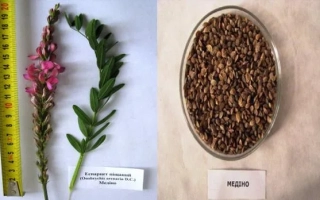
Petushok is a species of esparcet (Onobrychis Mill.), a perennial herbaceous plant that is characterized by early maturity: the vegetation period from the beginning of spring regrowth to the first cut is 59‑78 days, and full seed maturity is 95‑123 days. The bush is upright, stems are sparsely pubescent, leaflets are delicate, and the inflorescence is a loose spindle-shaped raceme. Seeds are small, kidney-shaped, and brown; the mass of 1000 seeds ranges from 3.3 to 5.0 g, and hardness constitutes 18‑23 %. In the Central Volga region, the average yield of dry matter reaches 45.1 c/ga, and in the Ural region – 44.6 c/ga.
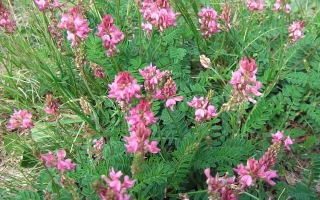
Esparcet Petushok is a valuable fodder and nectar-producing plant. Thanks to its high biological activity, it is perfectly suited for field seeding, lawn establishment on slopes, and sandy soils. The sowing rate for ordinary row bare-seed sowing is 70‑80 kg/ga, and under cover of spring crops – 100 kg/ga of viable seeds. When planted as field seedlings, from 3.5 to 4.5 million seeds per hectare are required.
The plant actively interacts with nitrogen-fixing bacteria, increasing soil fertility and providing protein-rich feed for livestock. Petushok can also serve as a decorative element thanks to its dense green foliage and attractive inflorescence. For successful sowing, it is recommended to prepare well-drained soil with sufficient sunlight exposure, loosen it to a depth of 15‑20 cm, and maintain sowing temperature in the range of 19‑25 °C.
Esparcet Petushok is a valuable fodder and nectar-producing plant. Thanks to its high biological activity, it is perfectly suited for field seeding, lawn establishment on slopes, and sandy soils. The sowing rate for ordinary row bare-seed sowing is 70‑80 kg/ga, and under cover of spring crops – 100 kg/ga of viable seeds. When planted as field seedlings, from 3.5 to 4.5 million seeds per hectare are required.
The plant actively interacts with nitrogen-fixing bacteria, increasing soil fertility and providing protein-rich feed for livestock. Petushok can also serve as a decorative element thanks to its dense green foliage and attractive inflorescence. For successful sowing, it is recommended to prepare well-drained soil with sufficient sunlight exposure, loosen it to a depth of 15‑20 cm, and maintain sowing temperature in the range of 19‑25 °C.
Crop & resistance
Crop
Specifications
| Usage Type | |
|---|---|
| Registration year | 1995 |
| Catalog | Catalog → Sainfoin |
| Legal data |
Show · 5
|
| Country | Russia |
No reviews yet. Be the first to share your experience.


See also
Often considered together with this variety






Recently viewed
Products you’ve viewed on this site
Reviews