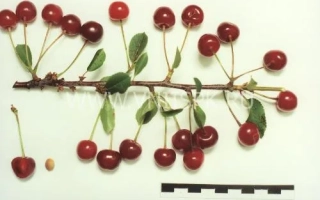
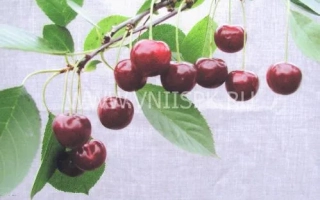
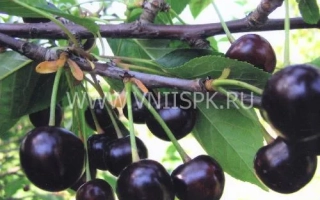
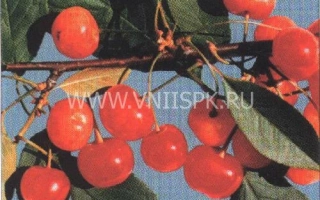
Widely distributed in the Middle and Lower Volga regions, a popular cherry variety of folk selection. It has many forms closely resembling it morphologically and biologically, locally known as Metelka Volzhskaya, Gorkovskaya, Dolgostebelka, etc. It was officially approved in 1947 and included in the State Register for the Central region.
Plants of this variety are characterized by a wide-pyramidal, dense crown with upward-growing branches; up to 5 m tall. It can grow as a tree or shrub, producing abundant suckers and is usually propagated by them. The trunk has a rough bark, brown with a grayish coating. Main branches are brown, with cracked and peeling bark, branching off the trunk at acute angles. One-year-old branches are thin, light brown, with a silvery-gray coating up to the middle. Vegetative buds are pointed, generative buds are oval. Leaves range from small to medium, 85 x 44 mm, flat, elongated-oval or oval to narrowly inverted-ovate, matte or slightly glossy, with fine, doubly serrated edges; petioles thin, up to 20 mm long; glands usually absent; stipules lanceolate, with sharp brown tips along the edges. Flowers occur in clusters of 3-5, small, 20-25 mm in diameter, with broadly oval petals, 11 x 9 mm, having a blunt base and rounded, notched apex; calyx bell-shaped, green, with intense anthocyanin pigmentation on the sunny side. Stigma is located at the same level as or above the stamens. Inflorescences are borne on a common axis 25-35 mm long, flowers within the inflorescence have pedicels 25-35 mm long. Fruits develop as bush-type cherries: predominantly on one-year-old branches, only 10% on flower clusters.
Fruits form in clusters of 1-3, small, 13 x 14 x 14 mm, weighing 2.0-2.8 g, round or flat-round, black-red, nearly black, slightly compressed on the ventral suture, with a rounded apex and small, dense pit; ventral suture barely discernible. Flesh is dark red, medium juicy and dense, sweet-sour, satisfactory, slightly astringent flavor; juice intensely red. In Leningrad Oblast, fruits contain: dry matter — 14.2%, sugars — 9.4%, free acids — 2.0%, ascorbic acid — 12.8 mg per 100 g fresh weight; in Central Russia: sugars — 10.4%, free acids — 1.9%; in southern horticultural zones: dry matter — 17.9%, sugars — 11.8%, free acids — 1.5%, ascorbic acid — 11.6 mg per 100 g. Stone is small, 7.5 x 7.5 x 6.0 mm, weighing 0.26 g, making up to 10% of the fruit’s total mass, round, light brown, smooth, with rounded base and apex, well-defined ventral suture, easily separates from flesh. Pedicel 40-52 mm, thin, with intense anthocyanin pigmentation, detaches from fruit with dry separation upon full ripening. Fruits are valued as raw material for processing, characterized by high transportability. Due to excessive acidity, they are limited in use fresh.
Plants grafted by suckers enter fruiting at 5-6 years, grafted ones — at 2-3 years after planting. Flowering time falls into the medium group, ripening — medium-late (end of July). Self-sterile, good pollinators include Vladimirskaia, Zhukovskaya, Lyubskaya, Polzhir, Ukrainka. Rastunyia belongs to the high-yielding group. In the Volga region, under full fruiting, productivity reaches 18-25 kg per tree. In Volgograd, 8-year-old trees yielded 22 kg, while 5-7-year-old trees over 3 years yielded an average of 15.9 kg. In Crimea, the maximum yield recorded was 61 kg per tree. In the Volga region, Rastunyia is classified as winter-hardy — only generative buds freeze in severe winters. In Central Russia, it exhibits average winter hardiness and cold resistance — branches may freeze in severe winters; in northern latitudes (Leningrad Oblast), it behaves similarly to the Volga region, but one-year-old branches may also freeze. Moderately affected by fungal diseases — coccomycosis and moniliosis; in southern horticultural zones, infections may be significant (coccomycosis up to 4-5 points). Occasionally affected by cherry sawfly.
In the Volga region, Rastunyia is the most widespread variety. Besides high winter hardiness and productivity, rootstock plants exhibit high drought tolerance, are not demanding of soil types, but suffer from gummosis on very dry sites.
Advantages: high winter hardiness and drought resistance of plants, good transportability of fruits.
Disadvantages: small fruit size and excessive acidity of fruits, susceptibility to fungal diseases, significant height of plants complicates care and harvesting.