


SKU #3726
·
439 views
Sweet cherry Adelina
Cherry, Sour Cherry
Type of Variety
Sweet cherry
Your mark
0 votes
0% positive ratings
Store offers · 2 from 2 stores
2 offers in 2 stores — from 5.16 € per seedling.
Available at: biolocus-plant-pro · Сад от А до Я
Prices are collected automatically from store websites and converted at the current exchange rate. Check the price and availability on the store website before ordering.
Description
Obtained by crossing varieties Slava Zhukov x Valeriy Chkalov. Originators — All-Russian Research Institute of Genetics and Selection of Fruit Plants and All-Russian Research Institute of Fruit Crop Selection. Authors: O.S. Zhukov, L.A. Shchekotova, E.N. Dzighadlo, A.A. Gulyaeva, Z.E. Ozheryleva. Under state variety testing since 2001.
Medium-sized tree, up to 3.5 m tall. Pyramidal, spreading, elevated crown of medium density. Shoots medium, straight, brown, without hairs. Bark on trunk and main branches smooth, gray. Bud 4.0 mm, oval shape, slightly deviated from shoot. Leaf egg-shaped, green. Apex sharply pointed. Base rounded, serrated edge coarsely toothed (double-tipped toothed). Leaf blade surface smooth, matte, concave, curved downward. Stipules located at base of leaf blade and petiole. Petiole 36.0 mm long, 2.8 mm wide, with anthocyanic coloration along entire length. Bears fruit on flower clusters and previous year’s shoots.
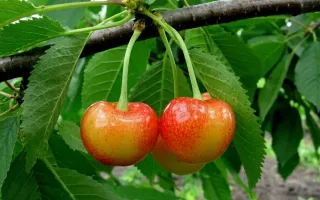
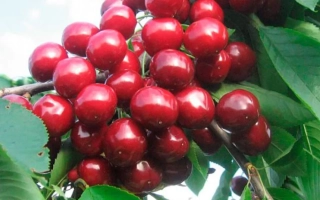
Fruits weighing 5.5–6.0 g, heart-shaped, 23 mm high, 23 mm wide, 24 mm thick. Fruit cavity wide, small, apex medium-elongated. Fruits dark red. Flesh dark red, medium density, slightly fibrous, juice red. Pedicel length 46.0 mm, thickness 0.8 mm. Stone rounded, 0.2 g, 3.6% of fruit weight, light yellow. Apex pointed, base rounded, separates easily from flesh.
Fresh fruit tasting score 4.7 points. Good fruit detachment from pedicel. Dessert variety. Fruits contain 16.2% dry matter, 11.9% sugars, 0.6% acids.
Flowering at medium time (May 10–15). Fruit ripening at medium time (July 15). Enters fruiting on 4th year. Self-sterile, good pollinators are medium-ripening cherry varieties. Average yield 79.1 centners per hectare, maximum 142 centners per hectare. Excellent winter hardiness of tree, medium winter hardiness of flower buds. Relatively resistant to coccomycosis and moniliosis.
Advantages: good yield, high fruit taste and market qualities.
Disadvantages: relative resistance to coccomycosis and moniliosis.
Video · 4 videos
Suggest a video →Crop & resistance
Crop
Disease resistance
Specifications
| Type of Variety | |
|---|---|
| Catalog | Catalog → Cherry, Sour Cherry |
No reviews yet. Be the first to share your experience.
Alternatives
Cherry saplings · similar varieties


See also
Often considered together with this variety


Recently viewed
Products you’ve viewed on this site
Reviews