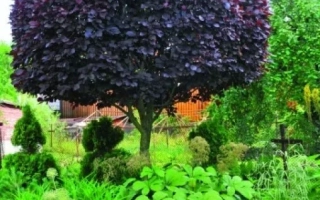
Chokecherry (Prunus serotina) – a large ornamental tree, reaching a height of up to 30 m and a width of about 30 cm thanks to rapid growth: annual growth in height is 50–70 cm. The bark is dark‑cherry, smooth and fragrant; leaves are broadly lanceolate, up to 12 cm long, dark‑green with a bronze tint; they shine from above and lighten from below, turning yellow and red in autumn.
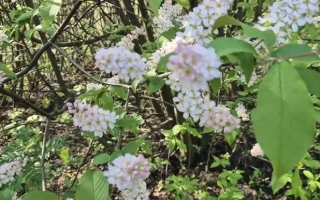
Late flowering chokecherry blooms 2–4 weeks later than the common variety. Fragrant‑less white flowers, up to 1 cm in diameter, are arranged in narrow cylindrical racemes up to 14 cm long. After flowering, edible drupelets are formed, first red, then black, up to 1 cm in diameter, with a characteristic bitter taste.
Chokecherry is valued as an ornamental tree due to its wide spreading crown, abundant spring and summer flowering, as well as autumn leaf and fruit coloration. It is well suited for single planting, group compositions, and alley rows, but does not tolerate shade, preferring open sunny garden areas.