


SKU #3487
·
552 views
Apple Prikubanskoye
Apple
Prices in stores
No offers yet — stores have not added prices for this product yet.
Similar varieties with prices
All offers: Apple saplings
Type of Variety
Winter Apple Variety
Your mark
0 votes
0% positive ratings
Description
The variety was obtained at the North Caucasus zonal Research Institute of Horticulture and Viticulture (Krasnodar) from crossing Red Delicious and Opal varieties. Authors of the variety: L. M. Sergeev, E. I. Kostetskaya, L. S. Naumova, V. E. Kharina, I. L. Efimova, T. G. Prichko. A promising late-winter variety has been in the State Register since 1996, widely used in new plantings, and included in the State Register for the North Caucasus region since 2003.
The tree is pyramidal with wide, then spherical or wider sparse crown in young age. Trunk is brown-gray. Skeletal branches go off at an angle close to straight, almost straight, located compactly, ends of the branches are directed upwards. Bears fruit mainly on simple and complex spurs.
Shoots are knee-bent, round in cross section, slightly pubescent, reddish-brown to dark cherry color. Leaves are green, smooth, matte, with delicate venation, pubescent, elongated, oval with rounded base and medium-elongated tip. Petiole is long, on the sunny side from dark red to dark cherry; also colored below the leaf central vein along its entire length in upper leaves, in middle and lower ones — more often up to the middle. Leaf margin is very strongly curved, serrate-dentate, with alternating step.
Flowers are large and medium in size, saucer-shaped, white with a weak pinkish tinge, with pubescent central part of pistils along its length; their stigmas are at the same level as stamens.
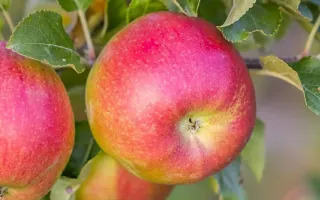
Fruits are large, rarely above average in size, one-dimensional, spherical or round-conical shape, even or slightly ribbed. Fruit surface is smooth or weakly tuberous. Main color when picked is greenish-yellow; becomes yellow during storage. Covering — solid blush from light to dark carmine, occupies half of the fruit and more. With late picking, fruits are colored almost completely. Subcutaneous points are clearly visible. Skin is smooth, dry with a weak waxy coating. Pedicel is medium in length and thickness. Funnel is of average depth and width. Calyx basin is medium in width and depth, weakly ribbed. Calyx is closed or half-closed. Hypanthial tube is usually funnel-shaped. Axial cavity is of average size; seed chambers are open with narrow slits.
Fruits are attractive, appeal rating 4.6-4.8 points.
Pulp is light yellow with a creamy tinge, often light carmine under the skin and near the calyx, sour-sweet, with weak aroma, very juicy, dense. Taste is good; improves during storage. Chemical composition of fruits: dry matter — 12.9-15.3%; sugars — 10.3-11.0%; acids — 0.40-0.64%; ascorbic acid — 10.9-13.0 mg/100 g, P-active substances — 100 mg/100 g.
Fruits store very well; do not lose quality until May, and are excellent for transportation. Rarely there is appearance of «bitter pitting» in some fruits during storage. Fruit commerciality is very high — 90-95%.
Early bearing, trees bear fruit on the fifth year after planting on a clonal semi-dwarf rootstock. Productivity of 14-year-old trees reaches up to 130 kg/tree. Productivity of the variety increases when planted according to dense schemes: 4-5 x 2-3 m. Fruiting is almost regular.
In extreme weather conditions in recent years, the variety has shown high winter hardiness and drought resistance. The variety is practically resistant to powdery mildew and brown spot, slightly susceptible to scab.
Merits of the variety: high commerciality of fruits, long storage duration, adaptability of crown to planting at high densities; fruits are firmly held on branches during ripening.
Drawbacks of the variety: fruits have an unpronounced taste when picked prematurely.
Crop & resistance
Crop
Disease resistance
Specifications
| Type of Variety | |
|---|---|
| Catalog | Catalog → Apple |
No reviews yet. Be the first to share your experience.
Alternatives
Apple saplings · similar varieties



See also
Often considered together with this variety



Recently viewed
Products you’ve viewed on this site
Reviews