


SKU #3489
·
239 views
Apple Primorsky
Apple
Type of Variety
Winter Apple Variety
Tree: Growth Power
Medium-height
Tree: Canopy Shape
Round Canopy
Fruit: Fruit Shape
Flat-round
Your mark
0 votes
0% positive ratings
Store offers · 1 from 1 store
1 offer in 1 store — from 13.2 € per seedling.
Available at: Agrosnab-market
Prices are collected automatically from store websites and converted at the current exchange rate. Check the price and availability on the store website before ordering.
Description
This variety was developed at the Far Eastern Research Institute of Agriculture by A. V. Bolonyev through a cross between the Burya and Aporth in 1938. The first large-fruited variety of Far Eastern selection. Limited cold and scald resistance, sufficient for cultivation in open-stem form in the warmest southern coastal zone of Primorsky Krai. Grafting onto the crowns of highly cold-resistant scaffold-forming varieties — Raneck and Siberian berry apple — allows cultivation in favorable conditions in collective and private gardens in more northern zones of Primorsky and southern Khabarovsk Krai. In the form of a cordon with light winter covering, it is suitable for cultivation in the Jewish Autonomous and Amur regions, as well as in the Baikal-Amur Mainline zone up to Komsomolsk-on-Amur, Sovetskaya Gavan, and the port of Vanino.
Medium-growing tree with a rounded, sparse crown, slender flexible branches and subsequent orders, allowing easy shaping of the crown in cordon form.
Medium-length and thickness shoots, straight, bordeaux-green, slightly hairy. Leaves medium-sized, oval-elongated with serrated edges. Leaf blade dense, slightly wavy, hairy underneath. Upper surface of leaf dark green, underside light matte. Petiole short, medium thickness, hairy, greenish-red.
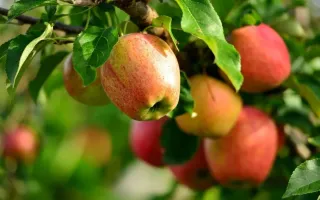
Medium-sized fruits (average mass 70 g, maximum 118 g), one-dimensional, flat-round, almost radish-shaped, smooth surface. Main skin color yellow-green, covering color solid or striped burgundy blush. Fruit stalk short, medium thickness, fitting into a wide and deep, heavily rusted cavity. Calyx wide and deep, cup half-open.
Flesh white with a reddish tinge from the skin, finely granular, juicy, slightly acidic-sweet wine flavor, very pleasant. Flavor-wise, it does not fall short of good European table varieties. Fruits contain: total sugar — 11.2%, total acid (converted to malic) — 0.8%, pectin substances — 0.3%, tannins — 0.4 mg/100g, ascorbic acid — 17.2 mg/100g.
Harvesting maturity occurs in the second half of September. Fruits become suitable for consumption within 15–20 days. Storage life in storage rooms up to 80 days, and in cold storage up to 120 days.
Begins fruiting at 3–4 years, mass fruiting at 6–7 years. Yield is relatively high and annual. At the beginning of fruiting, yield is up to 5 kg per tree, and at ages 8–11 years — 38–46 kg.
Fully resistant to scab and relatively resistant to monilial scorch.
Advantages of the variety: large fruits for local varieties, high-quality table fruits with prolonged storage life, one of the best varieties of Far Eastern selection, resistant to scab and monilial scorch.
Disadvantages of the variety: limited cold and scald resistance of trees, short productive period.
Used in interspecific crosses to improve fruit size and flavor qualities of local half-cultivars.
Crop & resistance
Crop
Disease resistance
Specifications
| Type of Variety | |
|---|---|
| Tree | |
| Growth Power | |
| Canopy Shape | |
| Fruit | |
| Fruit Shape | |
| Flesh color | |
| Fruit Color (Base Color) | |
| Blush (Blush Color) | |
| Fruit mass | 70-118 |
| Keeping quality | 2.5-4 |
| Catalog | Catalog → Apple |
No reviews yet. Be the first to share your experience.
Alternatives
Apple saplings · similar varieties




See also
Often considered together with this variety


Recently viewed
Products you’ve viewed on this site
Reviews