


SKU #3373
·
539 views
Quinty
Apple
User rating
0 votes0% positive reviews
No ratings yet — be the first.
Type of Sort
Summer apple variety
Prices in stores
from2.94 €per seedling
pack from 1.72 € per 1 pcs
5 offers from 4 stores
Store offers · 5 from 4 stores
Prices are updated on loadLoading offers…
Available at: Agro-landing · Evrosag · LeafLand · Наша Дача · Sadovnikoff · Світ Рослин · Ycadba
Aggregator catalog: prices are collected automatically from store websites, normalized by AI and converted at the current exchange rate. Before ordering, confirm the price and availability on the store's website. This block is not indexed by search engines — the data is loaded after the page opens.
About product

A summer variety developed in Canada through the crossbreeding of Crimson Beauty x Red Melba, it became widely cultivated since 1986 and was included in the State Register for the Central Chernozem, North Caucasus, and Lower Volga regions. It has gained extensive cultivation and regional approval in Voronezh, Lipetsk, Kursk, Rostov, Volgograd, Astrakhan regions, Krasnodar Krai, and the republics…
Type of Sort
Summer apple variety
Description
A summer variety developed in Canada through the crossbreeding of Crimson Beauty x Red Melba, it became widely cultivated since 1986 and was included in the State Register for the Central Chernozem, North Caucasus, and Lower Volga regions. It has gained extensive cultivation and regional approval in Voronezh, Lipetsk, Kursk, Rostov, Volgograd, Astrakhan regions, Krasnodar Krai, and the republics of Kabardino-Balkaria and North Ossetia.
Medium-sized tree with a broad, somewhat sparse, spreading crown and drooping lower branches. Highly leafy. Skeletal branches of medium thickness, curved, diverge from the trunk nearly at a right angle, have smooth bark with a greenish-gray hue. The trunk is light brown with a grayish tint and has a flaking surface. Fruiting organs — buds, predominantly located on last year's wood. On multi-year wood, spurs and occasionally fruiting spurs form.
Shoots of medium length and thickness, slightly curved, dark green, with a light brown coloration on the sunny side, weakly pubescent, nearly bare. Rare stipules are clearly visible, with round and oval shapes. Internodes of medium length. Buds large, narrowly conical.
Leaves are arranged at a 60° angle to the shoots, occasionally at 90°. Leaf blade dark green, equilateral, large, broadly oval or occasionally egg-shaped with a broad base. Leaf margin smooth with shallow lobing. Apex broadly cuneate with a gradually or abruptly tapering tip. Pubescence on the underside is moderate, occasionally weak, woolly. Petiole long and medium, slightly pubescent. Bracts of medium size, lanceolate.
Flowers large, occasionally medium-sized, white. Pistil positioned at the level of stamens, densely hairy at the base.
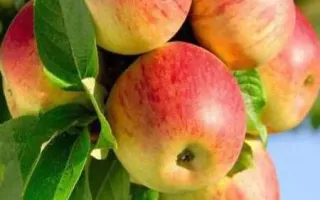
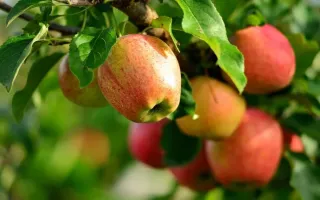
Fruits (see image) of medium size, occasionally large at low yields, relatively uniform, round or elongated-conical in shape, surface smooth. At harvest maturity, fruit color is greenish-yellow, with a continuous skin, often exhibiting a dark red or orange-red blush with a pinkish tint on most of the fruit. On poorly illuminated surfaces, intermittent stripes are visible against a weak marbled blush or base color. Numerous lenticels, white or occasionally gray, medium-sized, clearly visible. Fruit skin smooth, occasionally with a slight waxy coating, medium thickness, with a strong aroma. Pedicel of medium thickness and size, located at the edge of the calyx or often protruding beyond it. Calyx wide and relatively deep. Receptacle small, occasionally medium-deep, narrow, finely and medium-ribbed with visible pearls. Calyx tube closed, medium-sized. Subcalyx tube large, deep, usually funnel-shaped, occasionally conical. Central cavity very large, with widely open seed chambers. Seed cavity bulbous-shaped, large, positioned closer to the base of the fruit.
Fruits contain a medium number of large and medium-sized, broadly egg-shaped, brown seeds.
Flesh greenish at harvest, creamy at full maturity, firm, juicy, tangy-sweet, pleasant taste. Chemical composition of fruits: dry matter — 15.9% (maximum 16.8%), total sugars — 10.3% (11.2%), titratable acids — 0.53% (0.6%) on fresh weight, ascorbic acid — 8.4 mg/100g (11.2), sugar-to-acid ratio — 21.1 (35.6).
In the Lower Volga region, fruits ripen very early, in mid-July, and are classified as early-ripening, ultra-early maturing varieties. Harvest maturity coincides with consumer readiness. Fruit transportability is moderate. Fruit quality significantly declines during long-distance transport.
Fruits can be stored for no more than ten days.
Self-incompatible.
Trees enter fruiting early. Yield is 102–120 kg per tree. Fruit production is regular. Winter hardiness is moderate in southern areas and insufficient in the central zone. The variety is sensitive to scab but highly resistant to powdery mildew.
Advantages of the variety: fruits ripen very early, with a pleasant, tangy-sweet flavor and strong aroma; trees enter fruiting early; drought and heat resistance of the variety are relatively high; resistant to powdery mildew.
Disadvantages of the variety: insufficient winter hardiness in the central zone, requires protection against scab, especially in areas with significant rainfall; short fruit storage life and low transportability.
Video · 1 video
Suggest a video →Crop & resistance
Crop
Disease resistance
Specifications
| Type of Sort | |
|---|---|
| Catalog | Catalog → Apple |
Not yet комментариев. Be the first!
Alternatives
Apple saplings · similar varieties






See also
Often considered together with this variety


Recently viewed
Products you’ve viewed on this site
Reviews · 0