


SKU #3409
·
298 views
Luch
Apple
User rating
0 votes0% positive reviews
No ratings yet — be the first.
Type of Sort
Summer apple variety
Prices in stores
from6.01 €per seedling
pack from 7.4 € per pack
6 offers from 4 stores
Store offers · 6 from 4 stores
Prices are updated on loadLoading offers…
Available at: Зелёная Фазенда · Королевский сад · Лучший Сад · Agromir
Aggregator catalog: prices are collected automatically from store websites, normalized by AI and converted at the current exchange rate. Before ordering, confirm the price and availability on the store's website. This block is not indexed by search engines — the data is loaded after the page opens.
About product

Early-ripening apple variety of intensive type, promising for short-cycle orchards, selected by the North Caucasus Regional Institute of Horticulture and Viticulture, obtained from the varieties Melba and Kuban Spur using mutagenic selection. Authors: S. N. Artiukh, T. G. Prychko. The variety was officially approved for the North Caucasus region since 2004. It is widely grown in industrial, OPH,…
Type of Sort
Summer apple variety
Description
Early-ripening apple variety of intensive type, promising for short-cycle orchards, selected by the North Caucasus Regional Institute of Horticulture and Viticulture, obtained from the varieties Melba and Kuban Spur using mutagenic selection. Authors: S. N. Artiukh, T. G. Prychko.
The variety was officially approved for the North Caucasus region since 2004. It is widely grown in industrial, OPH, kolkhoz, farm, and hobby orchards in the North Caucasus region, covering more than 200 hectares. Promising for orchards in southern Russia.
Medium-sized tree, spur-type. Fruit set on buds, spurs, and one-year-old shoots. Bark gray and smooth. Main branches grow at a sharp angle.
Shoots of medium thickness, straight or slightly curved, with short internodes, bordeaux-green, slightly hairy on the upper part of new growth, with many buds. Buds are pressed, large, round, hairy. Leaves are upright, medium-sized, nearly round, spirally twisted, green, finely wrinkled, highly glossy, slightly hairy on the underside, blade nearly flat, leaf margin deeply toothed and wavy, petiole long, pinkish at the base.
Flowers are medium-sized, bowl-shaped, pinkish, petals free, aromatic, hairy style short, stigma slightly above the anther level. Anther bases are located at the middle of the style tube. Flowering occurs early.
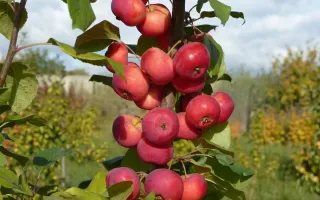
Fruits are large and very large, 170-220 g, flat, surface smooth, regular shape. Calyx wide, small, flat, without roughness, but forms a five-pointed "plate" at the base of the calyx, open, with short sepals; subcalyx tube short, conical; receptacle narrow, deep, moderately rust-colored; pedicel medium length, thick. Fruit color at harvest is light-green with a blurred reddish-purple blush on the sun-exposed side, with striped coloration on the shaded side. During storage, the color deepens to dark-purple. Skin is dense, glossy, covered with a light bloom. Under-skin spots are whitish, large, noticeable. Central cavity is medium, seed chambers open oval openings up to 3 mm. Flesh is dense, white, with strong aroma, slightly acidic-sweet, excellent in taste. Seeds are light-brown, inversely egg-shaped.
Fruit marketability is 80%. Fruit pulp has high pectin content. Fruits can be stored in a refrigerator for 2-3 weeks. Chemical composition: dry matter 12-15%, sugars 11-12.5%, acids 0.45-0.65%, pectins 14.0%, ascorbic acid 14.5 mg/100g, total P-active substances 172 mg/100g.
Trees begin fruiting as early as the 2nd year in the orchard. By the 5th year, on a low-growing rootstock at a planting density of 1000 trees/ha, yield reaches 100-150 centners/ha; by the 10-14th year, 400-450 centners/ha. On improved agrofond, yield increases to 500-600 centners/ha. Harvesting occurs at the end of June to early July.
Self-sterile; best pollinators: Alenushkino, Vadimovka, Mantet, Belosnezhka, and others. Own pollen is defective in years with late frosts.
Advantages: high cold and winter hardiness; relatively resistant to scab and powdery mildew; variety meets requirements of intensive orchards; high dessert and technological qualities of early-ripening fruits.
Disadvantages: trees require special protection against fruit borers. Under acute soil and air moisture deficit, fruit set and fruit drop occur. Fruit skin is sensitive to copper-containing protective agents. Short fruit storage period.
In breeding, the variety Luch is a donor of traits: late ripening and early fruiting.
Crop & resistance
Crop
Disease resistance
Specifications
| Type of Sort | |
|---|---|
| Catalog | Catalog → Apple |
Not yet комментариев. Be the first!
Alternatives
Apple saplings · similar varieties


See also
Often considered together with this variety




Recently viewed
Products you’ve viewed on this site
Reviews · 0