Late-autumn immune variety to scab (814 — self-pollinating) from the All-Russian Research Institute of Fruit Crop Selection. Seeds selected from fruits of the 1981 harvest in the collection garden. In 1993, the seedling was recognized for its high commercial and consumer qualities and selected as elite. The first fruiting of the seedling was recorded in 1990. Breeders: E. N. Sedov, Z. M. Serova, V. V. Zhdanov, E. A. Dolmatov.
The variety was accepted for State Testing in the Central, Central Chernozem, and Lower Volga regions of Russia in 1998 and officially approved in 2001.
Trees of medium size with round crowns. Bark on the trunk and main branches smooth and brown. Predominant type of fruiting: simple and complex rings.
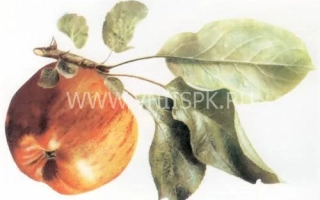
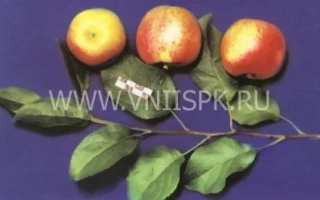
Shoots relatively thick, curved, arched, angular in cross-section, brown, hairy, with shortened internodes. Buds few. Buds pressed, large, conical, hairy. Leaves medium-sized, egg-shaped, short-pointed with spirally twisted tips, green, shiny, with coarse venation. Leaf margin serrated. Petiole short, thick, hairy.
Inflorescences umbrella-shaped, consisting of 4-6 flowers; buds white-pink; flowers plate-shaped, medium-sized with light pink, slightly closed petals of round shape; stigmas at the level of stamens; pedicel medium length; hairy fused style.
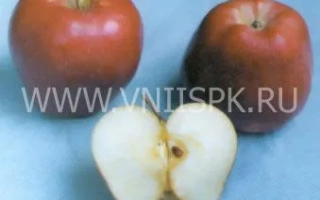
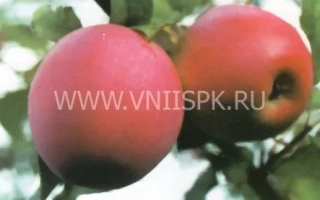
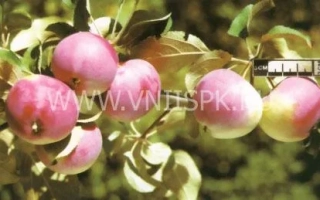
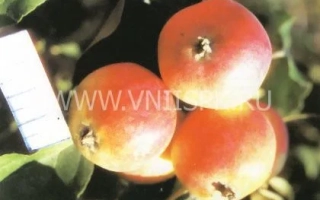
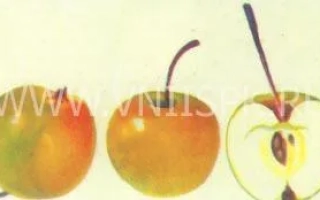
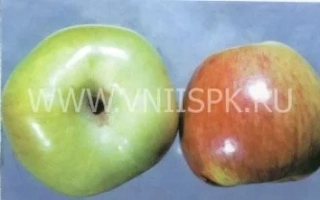
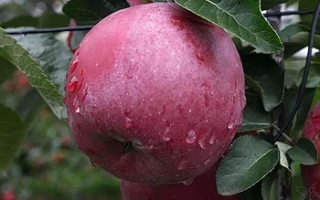
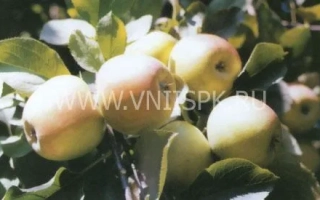
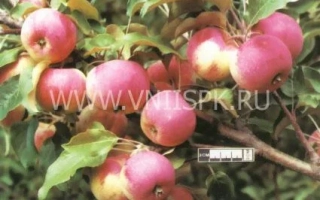
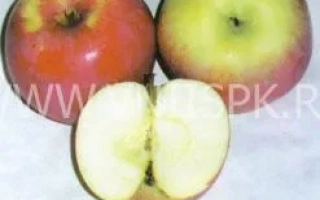
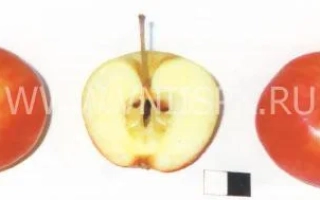
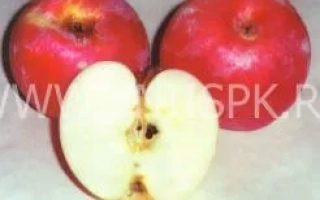
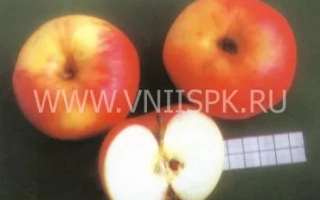
Fruits medium-sized (140 g), elongated, broad-ribbed, slightly tapered. Skin smooth and waxy. Main color at harvest stage greenish-yellow, and at consumer ripeness light yellow. Cover color across the entire fruit as a bright, solid raspberry blush. Numerous, large, clearly visible subdermal dots. Fruit stalk short, straight, oblique. Calyx funnel-shaped, narrow, acute-conical. Receptacle medium depth and width, ribbed. Calyx closed. Seed cavity medium-sized, bulbous. Seed chambers closed. Subcalyx tube medium depth and width, wedge-shaped. Seeds egg-shaped, light brown.
Flesh white, cream-colored, firm, fine-grained, very juicy. Fruits are rated 4.4 points for appearance and 4.3 points for taste. Chemical composition of fruits: total sugar — 7.9%, titratable acidity — 0.86%, ascorbic acid content — 7.2 mg/100g.
Harvest ripeness occurs from September 15 to 20. Consumer period lasts from October 10 to December.
High-yielding variety. Young 7-10-year-old trees grafted onto dwarf rootstocks (134 and 3-17-38) produced on average 107 centners per hectare over 4 years (1994-1997), while the control variety Antonovka ordinary yielded only 67 centners per hectare.
Cold-hardy variety. During artificial freezing of branches in January at -40 °C, buds froze to 1.6 points, bark to 1.0 points, and wood to 1.4 points (S. V. Rezvyakova). No visible signs of cambium damage were observed.
Advantages of the variety: resistance to scab (gene Vf), attractive late-autumn fruits.
Suitable for planting in intensive orchards on dwarf rootstocks (134 and 3-17-38).