



SKU #3474
·
309 views
First of Buryatia
Apple
User rating
0 votes0% positive reviews
No ratings yet — be the first.
Type of Sort
Autumn Apple Variety
Prices in stores
from27.86 €per seedling
pack from 13.37 € per pack
2 offers from 2 stores
Store offers · 2 from 2 stores
Prices are updated on loadLoading offers…
Available at: Агроном · Баргузин · Сибирский Оазис
Aggregator catalog: prices are collected automatically from store websites, normalized by AI and converted at the current exchange rate. Before ordering, confirm the price and availability on the store's website. This block is not indexed by search engines — the data is loaded after the page opens.
About product

Early autumn variety, selected at the Buryat Fruit and Berry Experimental Station. Obtained by crossing Purple Ranecki with Papirovka. Breeders: L. I. Dubrovskaya, I. A. Novoselova. Approved for the Republic of Buryatia in 1993. Widely grown in collective and private gardens in Buryatia, partially in Chita Oblast.
Tree is shrub-like, small, with an oval, medium-density crown. Bark on trunk and…
Type of Sort
Autumn Apple Variety
Description
Early autumn variety, selected at the Buryat Fruit and Berry Experimental Station. Obtained by crossing Purple Ranecki with Papirovka. Breeders: L. I. Dubrovskaya, I. A. Novoselova.
Approved for the Republic of Buryatia in 1993. Widely grown in collective and private gardens in Buryatia, partially in Chita Oblast.
Tree is shrub-like, small, with an oval, medium-density crown. Bark on trunk and main scaffold branches is brown. Branches are straight, compactly arranged, tips pointing upwards. Fruit-bearing is concentrated on simple whorls and shoots.
Shoots are brown, slightly hairy, medium thickness, straight, round in cross-section. Buds are small, few in number. Buds are medium-sized, round, slightly hairy, pressed against the shoot.
Leaves are dark green, base cordate. Margins are serrated. Blade is leathery, surface wrinkled, shiny, without hairs. Petiole is short. Stipules are lanceolate, reaching halfway or beyond halfway along the petiole.
Flowers are medium-sized, dish-shaped, white, stigmas positioned at the same level as stamens.
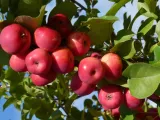
Fruits are of the semi-cultivar type, very small, one-dimensional, slightly flattened, round, symmetrical, smooth. Main skin color is cream-colored, covering color is pink, strong and diffuse. Skin is smooth and matte. Browning occurs only on the pedicel. Pedicel is medium length, thin. Calyx is small, wide, ribbed.
Flesh is creamy, very juicy, slightly aromatic, dense, fine-grained.
Fruits are attractive, flavor is good. Chemical composition of fruits: sugars — 12.6%, titratable acids — 0.99%, pectin substances — 0.6%, ascorbic acid — 8.8 mg/100g, P-active substances — 295 mg/100g.
Fruit maturation is early autumn.
Fruits are consumed fresh, used to make excellent natural juice, compote, and jam.
In some years, the variety exhibits self-fertility up to 33%. Good pollinators for it are varieties Yermolaev 23 and Komsomolitsa Buryatia. Enters fruiting at 4 years. Fruit-bearing is irregular. During full fruiting, yield is 26 kg per tree.
Cold hardiness and drought resistance are average. Not susceptible to diseases.
Advantages of the variety: sufficiently cold-hardy and productive, with good flavor and technological qualities, exhibits self-fertility.
Disadvantages: insufficient resistance to sunburn.
Used in breeding.
Video · 2 videos
Suggest a video →Crop & resistance
Crop
Specifications
| Type of Sort | |
|---|---|
| Catalog | Catalog → Apple |
Not yet комментариев. Be the first!
Alternatives
Apple saplings · similar varieties


See also
Often considered together with this variety


Recently viewed
Products you’ve viewed on this site
Reviews · 0