


SKU #3478
·
526 views
Apple Persianka
Apple
Type of Variety
Winter Apple Variety
Your mark
0 votes
0% positive ratings
Store offers · 3 from 3 stores
3 offers in 3 stores — from 6.9 € per seedling.
Available at: Лучший Сад · Питомник декоративных растений · Agromir
Prices are collected automatically from store websites and converted at the current exchange rate. Check the price and availability on the store website before ordering.
Description
Winter variety from the Sverdlovsk Experimental Garden Station, obtained by P. A. Dibrov and L. A. Kotov by crossing Persian and Kungur Ananas. Approved for the Ural region. As a new large-fruited variety, it is spreading in other areas of the Urals.
Medium-sized tree with an oval crown that becomes spherical with age, with few but fairly thick branches. Fruit set is mainly concentrated on spurs, less so on last year's growth.
Medium-thick, straight shoots, round in cross-section, with dark-brown bark, moderately hairy. Leaves are green, flat, round (occasionally broad-oval), with a heart-shaped base and short-tapered apex, finely toothed edges slightly raised, wrinkled surface, on short petioles, positioned at an acute angle (40-45º) to the shoot, with small, sickle-shaped or lanceolate stipules.
Flowers are fairly large, bowl-shaped, white, with long stigmas and stamens projecting above the anthers.
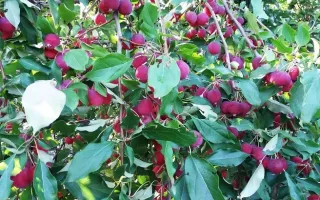
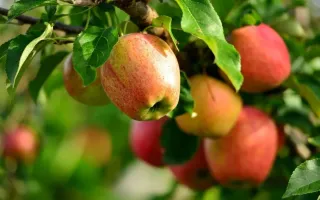
Fruits of medium size, weighing 100-120 g and larger (up to 180 g), ranging from round to broadly cylindrical shape, with almost indistinct ribs. Surface is smooth. Main color when harvested is greenish, later turning creamy, with a dense carmine-striped blush covering most of the fruit, and a bluish waxy bloom. Peduncle is short, calyx is medium-sized with slight rusting. Receptacle is medium or narrow, calyx closed. Core is onion-like, seed chambers are closed, subcalyx tube is narrow and conical. No axial cavity.
Flesh is creamy, juicy, granular, somewhat crunchy, with good or excellent sweet-tart flavor. Chemical composition: soluble solids — 12.9% (up to 16.8%), total sugars — 9.6% (up to 12.1%), titratable acids — 1.01% (up to 1.66%), ascorbic acid — 19.9 mg/100g flesh, polyphenols (catechins) — 195.3 mg/100g.
Fruits ripen by mid-September and can be stored up to 180 days.
Fruits remain firmly attached to the tree until harvest maturity, but begin to drop with wind. Fruit transportability is good.
Trees begin to bear fruit on the 6th-7th year after budding and produce marketable yields within 1-2 years. Variety has good productivity.
Winter hardiness of Persianka exceeds that of medium-Russian varieties. However, regarding fungal diseases, it should be noted that without spraying, the variety is susceptible to scab. But in dry conditions of Orenburg, Northern Kazakhstan, and southern Chelyabinsk region, scab does not appear.
Advantages of the variety: large fruit size, high marketability, flavor, and winter storage duration.
Disadvantages of the variety: susceptibility to scab.
Used in breeding — produces good offspring in crosses, notably yielding the variety 'Pervouralskaya'.
Video · 1 video
Suggest a video →Crop & resistance
Crop
Specifications
| Type of Variety | |
|---|---|
| Catalog | Catalog → Apple |
No reviews yet. Be the first to share your experience.
Alternatives
Apple saplings · similar varieties


See also
Often considered together with this variety



Recently viewed
Products you’ve viewed on this site
Reviews