


SKU #3454
·
330 views
Apple Ostanokino
Apple
User rating
0 votes0% positive reviews
No ratings yet — be the first.
Type of Sort
Autumn Apple Variety
Prices in stores
from1.95 €per seedling
pack from 2.34 € per pack
10 offers from 9 stores
Store offers · 10 from 9 stores
Prices are updated on loadLoading offers…
Available at: AgronomVIP · Чудеса Саду · Dacha-mart · Ecoveles · Голден Сад · Idea-Sad · Литинсад · Megasad · Posadka · Sadokshop · Сади Буковини
Aggregator catalog: prices are collected automatically from store websites, normalized by AI and converted at the current exchange rate. Before ordering, confirm the price and availability on the store's website. This block is not indexed by search engines — the data is loaded after the page opens.
About product

Autumn variety selected by VSTISP, one of the first domestic apple varieties with columnar crown type, obtained by crossing varieties Obil'noe × Vajak (1974). Author: V.V. Kichina. Approved in 2002. Widely grown in dachas and private gardens in the Moscow region, Perm, Samara, and other areas; promising in the non-chernozem and chernozem regions. The tree has a column-like trunk, densely cover…
Type of Sort
Autumn Apple Variety
Description
Autumn variety selected by VSTISP, one of the first domestic apple varieties with columnar crown type, obtained by crossing varieties Obil'noe × Vajak (1974). Author: V.V. Kichina. Approved in 2002. Widely grown in dachas and private gardens in the Moscow region, Perm, Samara, and other areas; promising in the non-chernozem and chernozem regions.
The tree has a column-like trunk, densely covered with fruiting structures (buds and shoots). The wood is unusually hard and rigid, does not bend under heavy fruiting, and buds live for 12-14 years.
Fruits are evenly distributed along the entire trunk, starting from 30-40 cm above the ground. Growth vigor — naturally dwarf; crown highly leafy; annual growth during full fruiting typically 5-10 cm.
Shoots are very thick, internodes shortened. Leaves large and elongated, dark green, glossy, inversely egg-shaped, flat with serrated edges, with medium-length petioles.
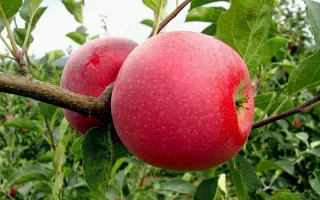
Fruits are medium to large, flattened-round, symmetrical. Surface smooth, base color greenish-yellow, covering color beautiful purple-red blush covering 2/3 or the entire fruit. Peduncle short, seed chambers closed, no central cavity.
Flesh white, very juicy, tart-sweet, good dessert flavor.
Ripening is autumnal, but fruits can be stored over winter.
Fruit set begins in the second year. Productivity of a five- to six-year-old small tree averages 6-8 kg, which, at the standard columnar planting density of 20,000 trees per hectare, yields 120-160 tons per hectare. With good care on dacha plots in many diverse locations, productivity increased to 10-12 kg, and even up to 16 kg per tree. Yield is regular, though it varies from year to year. Typical yield for this variety is 700-800 centners per hectare; with improved agrofond, it quickly rises to 1200-1600 centners per hectare, and on plots with long-term high agrofond, yields of 3000 centners per hectare are maintained for many years. Like its parent (variety Obil'noe), Ostanokino sets fruit well in bad weather during flowering and even in years when there were hardly any bees.
Winter hardiness comparable to variety Melba; disease and pest resistance at the level of the best standard varieties.
Advantages of the variety: high yield of high-quality fruit.
Disadvantages of the variety: first and foremost, for all columnar varieties, very expensive planting, as 20,000 trees must be planted per hectare; fruit quality of Ostanokino remains in the same class as Melba and Lobo; necessity of selecting one of 3-4 upper shoots annually to replace the top bud when it dies.
Video · 5 videos
Suggest a video →Crop & resistance
Crop
Specifications
| Type of Sort | |
|---|---|
| Catalog | Catalog → Apple |
Not yet комментариев. Be the first!
Alternatives
Apple saplings · similar varieties


See also
Often considered together with this variety




Recently viewed
Products you’ve viewed on this site
Reviews · 0