


SKU #62087
·
60 views
Tannat
Grape
Lazurnaya Yagoda LLCUser rating
0 votes0% positive reviews
No ratings yet — be the first.
Usage Group
Technical
Ripening Period
Late
Cold Resistance
Low (-18°C and below)
Resistance to Mildew
Low
About product

A technical variety perfect for crafting full-bodied, long-aging red wines.
Usage Group
Technical
Ripening Period
Late
Cold Resistance
Low (-18°C and below)
Resistance to Mildew
Low
Description
Tannat by "Lazurnaya Yagoda": A Premium Choice for Viticulture
Tannat is a demanding technical variety, designed for winemakers who prioritize structure and long-term aging potential. When sourcing cuttings from "Lazurnaya Yagoda," it is essential to recognize that this variety excels only in specific southern climates, where it can fully develop its deep, fruit-driven profile. It is the hallmark of wines with significant tannic complexity.
Cultivation Challenges and Management
Due to its high susceptibility to mildew, oidium, and gray mold, Tannat requires an uncompromising, strictly scheduled protection program. Integrating preventative measures is critical from early spring to harvest. Furthermore, with a cold hardiness threshold of -18°C, the variety mandates a cover-crop approach, requiring seasonal burial of the vines. While this increases labor intensity, it is the only way to ensure the long-term health and productivity of the vineyard in regions with winter risks.
Key Vineyard Specifications
- Usage: Technical; specifically for the production of full-bodied red wines.
- Ripening: Late; requires high active temperature accumulation zones.
- Yield: Low; however, this limitation is the primary factor in achieving concentrated, high-quality must.
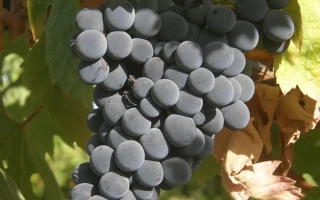
- Cluster Size: Medium (300–500 g), requiring precise fruit-load management.
Practical application of "Tannat" from "Lazurnaya Yagoda" is focused on producing terroir-driven, vintage-quality wines. The naturally low yield serves as a benefit for growers: when water stress and green harvesting are carefully managed, the grapes accumulate the dense polyphenolic structure necessary for wines capable of bottle-aging for decades. This is a high-reward variety for growers willing to invest in meticulous canopy management and disease control.
Video · 1 video
Suggest a video →Crop & resistance
Crop
Specifications hover over for a hint about the specification
| Usage Group | |
|---|---|
|
Ripening Period
Ripening Period
It takes 70-100 days until pepper reaches flowering stage, 130-160 days until technical fruit ripeness, and 135-180 days until physiological ripeness. |
Late |
| Cold Resistance | |
| Resistance to Mildew | |
| Resistance to oidium | |
| Resistance to Gray Mold | |
|
Yield
Yield
Overall bulb harvest per unit area. Depends on both onion variety characteristics and agronomic practices, fertilizers, and irrigation. Under optimal growing conditions, an onion yield of 100 tons per hectare and above is not considered record-breaking. |
Low |
| Bunch Size | Medium (300–500 g) |
| Berry Color | |
| Flavor | |
| Zoning | |
| Assignment | |
| Registration year | 2021 |
| Catalog | Catalog → Grape |
| Manufacturer | Lazurnaya Yagoda LLC |
| Country | Russia |
Store offers
Prices are updated on loadLoading offers…
Aggregator catalog: prices are collected automatically from store websites, normalized by AI and converted at the current exchange rate. Before ordering, confirm the price and availability on the store's website. This block is not indexed by search engines — the data is loaded after the page opens.
Not yet комментариев. Be the first!
Alternatives
Grapevine saplings · similar varieties




See also
Often considered together with this variety




Recently viewed
Products you’ve viewed on this site
Reviews · 0