
Disease
Especially harmful
Helminthosporium root rot
Bipolaris sorokiniana
Description
Symptoms
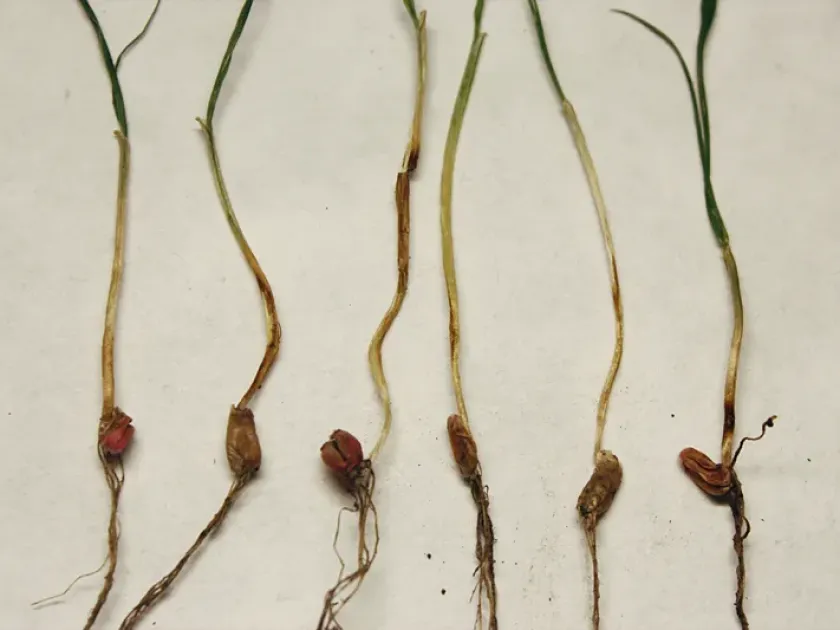
Infection often begins at the seedling stage, presenting as brown lesions on the coleoptiles and primary roots, which can result in pre-emergence damping-off.
As the plant develops, the subcrown internode becomes darkened and necrotic, severely restricting the movement of water and nutrients to the tillers.
Characteristic symptoms on leaves, often referred to as spot blotch, appear as dark brown or black oval spots with chlorotic haloes.
Severely infected plants often show reduced tillering, stunted growth, and premature senescence, often leading to the formation of "white heads" in wheat.
- Dark necrotic root lesions.
- Browning of the subcrown internode.
- Oval dark leaf spots.
- Stunted plant development.
- Reduced grain filling and shriveled seeds.
Pathogen
The disease is caused by the fungus Bipolaris sorokiniana (also known as Helminthosporium sativum), an aggressive pathogen that affects roots, stems, and leaves of cereals.
This fungus persists in the soil and on crop debris as spores (conidia) and mycelium, remaining viable for several seasons under adverse environmental conditions.
The pathogen is highly adaptable and can colonize various cereal species, including wheat, barley, and rye, effectively utilizing plant residues for survival.
During the growing season, the fungus produces large numbers of conidia which serve as primary and secondary inocula for rapid field spreading.
The infection process involves enzymatic degradation of plant tissues, leading to the characteristic necrotic lesions observed on both roots and subcrown internodes.
Conditions for development
The development of Helminthosporium root rot is favored by warm, moist conditions, with temperatures ranging between 20°C and 25°C being optimal for fungal activity.
Poor crop rotation practices, where cereals are grown consecutively, lead to a massive accumulation of the pathogen in the soil profile.
Environmental stress, such as drought, nutrient deficiency, or improper soil compaction, significantly increases the vulnerability of the plants to the fungus.
Heavy rainfall during the early vegetative stage facilitates the movement of conidia from the soil surface to the plant tissues, initiating widespread infection.
Low-quality seed contaminated with mycelium introduces the pathogen into new fields, rapidly establishing a persistent inoculum reservoir.
Why it matters
Helminthosporium root rot significantly reduces crop stands, leading to sparse fields and the need for costly replanting in extreme cases.
The disease causes substantial yield losses by reducing the number of productive spikes and causing poor grain filling due to impaired transport of nutrients.
The necrotic root system cannot sustain the plant during critical heat stress events, leading to lodging and premature death of the entire crop.
Infected grain often has low test weight and poor nutritional quality, impacting both market value and milling characteristics.
The cumulative effect of the disease in high-inoculum fields can lead to long-term decline in soil health and reduced productivity for susceptible crops.
Protection
The primary control strategy is the use of high-quality, fungicide-treated certified seeds to protect the crop during the most vulnerable initial stage.
Implementing a diverse crop rotation, involving broad-leaved crops or resistant varieties, is essential to decrease the soil inoculum level over time.
Effective soil management, including deep tillage and residue management, helps to accelerate the decomposition of fungal hosts in the soil.
Balanced fertilization, particularly adequate potassium and phosphorus levels, improves the plant's structural integrity and resistance to fungal colonization.
Foliar fungicide applications during the tillering and stem elongation stages are recommended to manage the disease if the infection pressure is high.
Reference
Connections · Helminthosporium root rot
Most often together:
Marketplace
Products · 254
All 254
Fungicides 233
Insecticides, Acaricides 10
Plant Growth Regulators 2
Wheat 2
Biological Products 2
Adjuvants 1
Herbicides, Desiccants 1
Corn 1
Sunflower 1
Rootstocks 1

Vitavax 200 FF
Crompton (Uniroyal Chemical) Registration Limited
Fungicides
1
0
18 offers
5.37 €per 1 l
Buy




Community
Discussion
No discussions yet — be the first.