
Description
Symptoms
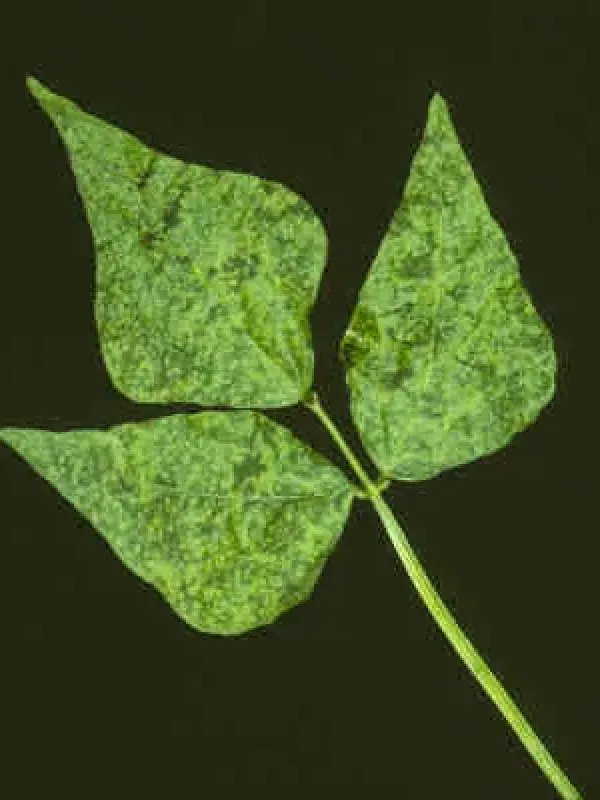
The primary symptom of Bean Common Mosaic is a distinct mosaic pattern on leaves, manifesting as an alternation of light and dark green patches. Leaf distortion, puckering, and curling are also commonly observed.
Plants infected early in development show significant stunting and dwarfism, often exhibiting a bushy appearance due to excessive development of lateral shoots. The leaf surface becomes wrinkled, which severely impacts the plant's photosynthetic capacity.
During the flowering period, infected plants frequently shed buds and flowers. The remaining pods develop slowly, may be malformed, and often contain seeds with spots or visible discolorations.
Systemic infection blocks the plant's vascular system, leading to premature yellowing and dropping of lower leaves. In highly susceptible cultivars, necrotic streaks may develop on the stems.
Visual diagnosis during early stages can be challenging as symptoms may resemble nutrient deficiencies; however, as the disease progresses, the mosaic pattern becomes characteristic and easy to identify.
Pathogen
The disease is caused by the Bean common mosaic virus (BCMV), which belongs to the Potyvirus genus. This is a rod-shaped phytopathogen that parasitizes living plant cells.
The virus is highly seed-borne, meaning that infected seeds serve as the primary source of infection in the field. The virus can remain viable within the seed for an extended period.
In addition to seed transmission, the virus is easily spread mechanically through contaminated farm equipment or by direct contact between infected and healthy plants during routine cultivation practices.
A biological feature of this pathogen is its systemic movement throughout the plant's vascular system, making it impossible to cure an infected plant since the virus eventually penetrates all tissues.
The existence of diverse viral strains necessitates rigorous control of seed lots, as some strains can overcome the resistance markers bred into modern bean varieties.
Conditions for development
Virus transmission in fields occurs predominantly via insect vectors, particularly various aphid species, which transmit the virus in a non-persistent manner while feeding on the plant sap.
Warm and dry weather conditions are ideal for aphid population growth, directly correlating with the rate of viral spread. High pest pressure during the vegetative growth phase significantly increases the risk of an outbreak.
Temperatures ranging from 20°C to 25°C are most favorable for viral replication within the plant tissues. Under these conditions, the virus reaches peak concentration in young leaves, causing the most severe symptoms.
Weeds from the legume family serve as reservoirs for the virus during the off-season. Aphids migrate from these wild hosts to agricultural bean crops, initiating primary infection centers.
Poor crop rotation practices and continuous cultivation of beans in the same area lead to the accumulation of inoculum in the soil and surrounding environment, increasing the likelihood of early season outbreaks.
Why it matters
The damage caused by BCMV manifests as a drastic reduction in crop yield, which can reach 50–80% in severe outbreak years. Plants often fail to produce pods or yield poor-quality, undersized seeds.
Seeds harvested from infected plants often exhibit low germination rates and poor vigor, ensuring that the next planting cycle will also be heavily infected if contaminated seed is used.
The virus disrupts metabolic processes, leading to the accumulation of inferior proteins and sugars in the grain, making the beans less marketable and prone to spoilage during storage.
Systemic infection lowers the plant's overall immune system, making it highly susceptible to secondary fungal and bacterial pathogens, which further complicates crop management.
Economic losses arise not only from reduced yields but also from the necessity to discard infected seed lots and the increased cost of insecticide applications required to control aphid populations.
Protection
The most effective strategy for managing the disease is the use of resistant bean cultivars. Breeding programs have successfully developed varieties with robust immunity to major BCMV strains.
Using certified, disease-free seed is mandatory. Before planting, it is highly recommended to screen seed lots for the presence of the virus using diagnostic tests like ELISA or PCR.
Systematic aphid control using insecticides during critical growth stages helps to significantly limit the transmission of the virus across the field.
Cultural practices, such as removing leguminous weeds in the vicinity and maintaining spatial isolation between different bean plantings, are essential to minimize infection risks.
If isolated infected plants are detected, they should be immediately rogued (removed) and destroyed (preferably burned) to prevent mechanical spread to neighboring healthy plants during field operations.
Content graph
Connections · Bean common mosaic
Most often together:
Marketplace
Products · 8


Community
Discussion
No discussions yet — be the first.