

Description
Symptoms
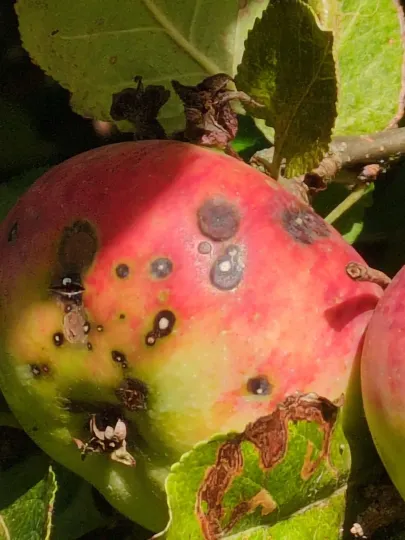
Initial symptoms appear as dull, olive-green, velvety spots on the undersides of young leaves. As the infection progresses, these spots darken, expand, and may lead to leaf curling and premature drop.
On fruit, symptoms present as roughly circular, dark, corky lesions. As the fruit continues to grow, these spots can harden and crack, leading to significant deformation.
In cases of severe infection, young fruit may drop prematurely, resulting in substantial yield losses. The quality of harvested fruit is severely compromised.
On twigs, the pathogen can cause small, blister-like lesions that eventually rupture, providing a site for secondary fungal infections.
- Olive-green spots on leaves.
- Dark, corky scabs on fruit surfaces.
- Deformed, cracked, and lopsided fruit.
- Premature leaf and fruit drop.
- Twig blistering and lesions.
Pathogen
The causal agent of apple scab is the ascomycete fungus Venturia inaequalis (anamorph Spilocaea pomi). This pathogen specifically targets the domestic apple tree.
The fungus overwinters primarily as mycelium or pseudothecia in fallen leaves. In early spring, during wet periods, these structures release ascospores that initiate primary infections.
Throughout the growing season, the disease is spread by conidia, which develop on existing lesions on leaves and fruit. Multiple infection cycles can occur during a single summer.
The fungus can also survive in dormant fruit buds, which facilitates early-season infection as soon as the buds begin to break and tissues are exposed.
The pathogen is highly adaptable to various environmental conditions, making it one of the most persistent and destructive diseases in apple production worldwide.
Conditions for development
Apple scab development is heavily dependent on moisture. Prolonged periods of leaf wetness are essential for the germination of fungal spores.
The optimal temperature range for the pathogen's growth is between 15°C and 22°C (59–72°F). High humidity or frequent rainfall triggers rapid spore dissemination.
Orchards with dense tree spacing and poor air circulation create a localized microclimate that traps moisture, significantly increasing the risk of infection.
Wind and rain splashes serve as the primary vectors for moving conidia from infected tissues to healthy leaves and fruit throughout the orchard.
Monitoring weather patterns and predicting "infection periods" is crucial for timing fungicide applications effectively during the spring and early summer.
Why it matters
The primary economic impact of apple scab is the degradation of fruit quality. Scabbed apples have little to no market value and are highly susceptible to secondary rots in storage.
Severe leaf infection leads to early defoliation, which reduces the tree's photosynthetic capacity, weakening the tree and lowering its overall yield potential for the following year.
Repeated defoliation makes apple trees more susceptible to winter damage and other environmental stressors, potentially reducing the tree's productive lifespan.
Management costs are significantly inflated due to the necessity of multiple fungicide applications, which are required for high-quality apple production.
In epidemic years, total crop failure is possible if environmental conditions remain favorable for the pathogen and protective measures are not implemented.
Protection
Sanitation is a cornerstone of scab control. Removing or destroying fallen leaves in the autumn significantly reduces the primary inoculum for the next spring.
Pruning is essential to improve airflow and sunlight penetration within the tree canopy, which helps foliage dry faster after rain, thereby discouraging spore germination.
Choosing resistant or tolerant apple cultivars is the most effective long-term strategy for minimizing disease pressure and reliance on chemical treatments.
Protective fungicide programs, timed according to bud development and wetness events, are commonly used in commercial settings to manage infection.
Integrated Pest Management (IPM) practices, including the rotation of fungicide classes to prevent resistance, are vital for sustainable and effective disease control.
In brief
1
Affects crops
Biology
Pathogens and affected parts
Pathogens
Affected plant parts
whole plant
Content graph
Affects crops · 1
Content graph
Connections · Apple scab
Most often together:
Marketplace
Products · 22






Community
Discussion
No discussions yet — be the first.