
Black scurf
Rhizoctonia solani
Description
Symptoms
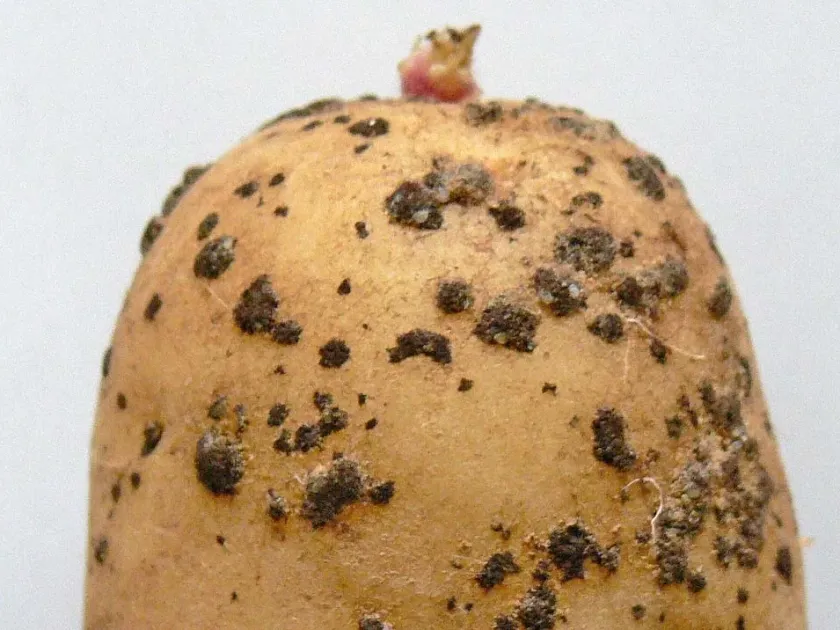
The most recognizable sign is the presence of hard, black, soil-like lumps (sclerotia) on the surface of mature potato tubers. These spots do not wash off, significantly affecting the appearance.
Early-season infection often appears as reddish-brown lesions on sprouts. In severe cases, these sprouts may be killed before reaching the surface, leading to poor emergence.
On adult plants, a white or gray fungal mycelium (the so-called white collar) may form around the base of the stem near the soil surface, causing restricted transport of nutrients.
Symptoms also include leaf curling, yellowing, or the formation of aerial tubers on the stems, which are signs that the root system has been compromised by the fungus.
Roots may show symptoms of necrosis, appearing brown or decayed. This leads to stunted plant growth and an uneven distribution of tuber sizes at harvest time.
Pathogen
Black scurf, or rhizoctonia, is caused by the soil-borne fungus Rhizoctonia solani. This pathogen is highly adaptable and can survive in various environmental conditions for extended periods.
The fungus produces hard, dark, irregular-shaped structures called sclerotia, which attach to the potato skin. These sclerotia are the primary survival structures that allow the disease to persist in the soil and on tubers.
Rhizoctonia solani has a wide host range, infecting not only potatoes but also numerous vegetable crops, legumes, and even turf grasses, making crop rotation essential.
In the absence of a host, the fungus can live as a saprophyte on organic matter in the soil, utilizing plant debris as a nutrient source to maintain its population density.
The biological cycle is triggered when environmental conditions become suitable for the fungus to develop hyphae from sclerotia, which then invade the plant tissues during germination.
Conditions for development
The disease thrives in cool, moist soil conditions, typically at temperatures between 8°C and 12°C. Cold springs are particularly hazardous for newly planted potatoes.
High soil moisture levels significantly promote the development of the fungal mycelium. Excessive rain or poor drainage during the early stages of growth increases infection rates.
Compacted, heavy soils tend to retain more moisture and provide a restrictive environment for plant growth, giving the pathogen an advantage in colonizing the roots.
The use of uncomposted manure can create a favorable environment for fungal activity, as the organic matter provides a ready substrate for the pathogen to thrive.
Poorly timed planting, where tubers stay in the ground for a long time before emergence, increases the duration of exposure to the fungus and thus the risk of black scurf.
Why it matters
The main impact of black scurf is reduced plant stand due to the death of sprouts, which directly correlates to lower yield potential and uneven crop development.
The infection disrupts the plant's ability to supply nutrients to the tubers, resulting in deformed, small, or cracked tubers that fail to meet market standards.
Tubers covered in sclerotia are often rejected by retailers, leading to direct economic losses for the farmer and reducing the overall profitability of the potato crop.
Black scurf-infected tubers have lower resistance to secondary infections, such as soft rot, which can cause significant losses during long-term storage in warehouses.
Furthermore, infected fields become "contaminated" with the pathogen, requiring long intervals before another potato crop can be safely planted in the same location.
Protection
The primary control measure is the use of high-quality, disease-free certified seeds. Treating seed tubers with effective fungicides before planting is standard practice.
Implement a sound crop rotation plan, avoiding the recurrence of potatoes in the same field for at least 3 to 4 years to break the infection cycle of the fungus.
Ensure that soil temperatures have risen sufficiently before planting to encourage rapid sprout growth, which allows the plant to outgrow the critical window of infection.
Optimize soil fertility and pH, and ensure good field drainage to prevent waterlogging, as these factors significantly influence the prevalence of the disease.
- Use resistant or tolerant potato varieties.
- Avoid deep planting in cold, wet conditions.
- Maintain weed control to limit alternative hosts.
- Practice good hygiene with agricultural equipment.
- Store harvested potatoes in cool, dry, well-ventilated areas.
Discussion
No discussions yet — be the first.