
Description
Symptoms
Symptoms appear on leaves, fruits, shoots, and blossoms. On leaves, the first signs are small, pale olive-green spots that gradually turn dark and velvety.
As the infection progresses, the spots on the leaves can become quite large, leading to premature leaf drop and weakening of the entire tree.
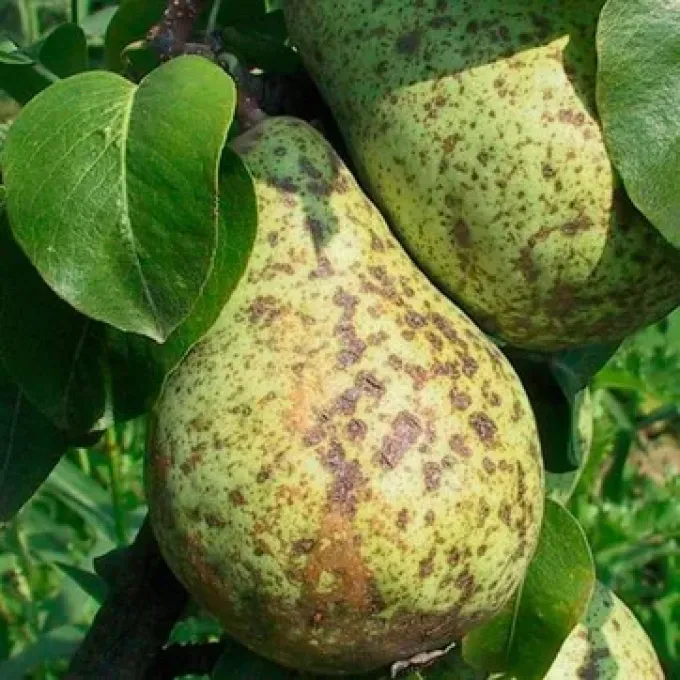
Infected fruits develop characteristic dark, round, corky spots. These lesions often cause the fruit to deform, crack, and lose its aesthetic appeal.
On young shoots, the fungus creates blister-like structures that eventually rupture, forming open cankers or lesions that may lead to dieback.
If the blossoms are infected, they may turn black and drop off, significantly reducing the potential yield even before the fruit begins to form.
Pathogen
Pear scab is caused by the fungus Fusicladium pyrorum (teleomorph: Venturia pyrina). This is a highly specific pathogen that primarily affects the common pear.
The life cycle involves both asexual (conidia) and sexual (ascospores) stages. The fungus survives the winter as mycelium in fallen leaves and on infected twigs.
In early spring, the fungus develops fruiting bodies called perithecia, which release ascospores. These spores are the primary source of infection for the new season's growth.
Once established, the fungus produces conidia, which are spread by wind and rain splashes, causing secondary infections throughout the growing season.
The pathogen is highly aggressive, with the ability to multiply rapidly whenever favorable environmental conditions arise in the orchard.
Conditions for development
The development of pear scab is heavily dependent on prolonged wet weather. Rain, heavy dew, and high humidity are the primary drivers of the disease.
The optimal temperature range for spore germination and infection is between 15°C and 20°C, provided there is free moisture on the plant surfaces.
Orchards with dense, poorly pruned canopies are particularly susceptible because they maintain higher humidity levels, which favor fungal proliferation.
Lack of sanitation, such as failing to remove infected plant debris, ensures a high level of primary inoculum for the following spring.
Summer rainfall, combined with moderate temperatures, can trigger additional outbreaks of scab, especially on susceptible pear varieties.
Why it matters
Pear scab causes significant economic losses by reducing fruit quantity and severely damaging the quality of the harvest.
Scab-infected fruits are rejected by markets, as they are unsightly, lack shelf-life, and are more susceptible to post-harvest storage rots.
Tree vigor is negatively impacted when heavy leaf infection leads to early defoliation, reducing the energy reserves needed for the next year's growth.
Persistent infections on branches can lead to the formation of cankers, which disrupt water transport and can ultimately kill branches.
In years with high disease pressure, total crop loss is possible if adequate chemical control measures are not implemented on time.
Protection
Good orchard hygiene is the first line of defense; this involves raking and destroying or composting fallen leaves to reduce the primary spore source.
Proper pruning is essential to improve airflow through the canopy, which helps leaves dry faster and reduces the duration of infection-favorable conditions.
Fungicide application is crucial, with specific attention paid to the "green tip" stage, the "pink bud" stage, and post-bloom treatments.
It is important to rotate products with different modes of action to prevent the development of resistance in the pathogen population.
- Selecting and planting resistant pear varieties to naturally limit disease spread.
- Maintaining tree health through proper fertilization and irrigation management.
- Using biological control agents as part of an integrated pest management (IPM) strategy.
Pathogens and affected parts
Affects crops · 1
Discussion
No discussions yet — be the first.