
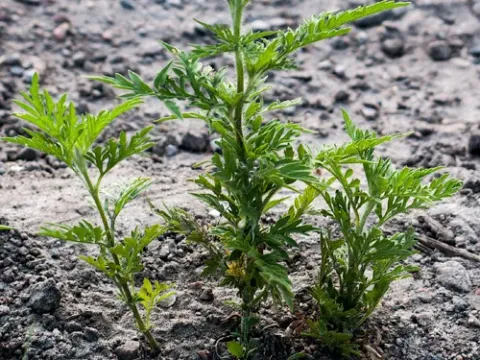
Iva xanthiifolia
Iva
Iva xanthiifolia, commonly known as rag sumpweed, is a problematic annual plant in the Asteraceae family. Seeds typically begin to germinate in early spring as soil temperatures reach 6 to 8 degrees Celsius, often preceding many major crops.
What the section contains


Iva xanthiifolia
The plant exhibits high seed vigor, allowing for emergence from depths of up to 12 centimeters. This deep emergence capacity makes standard shallow cultivation methods largely ineffective in controlling established weed populations.
Emergence can occur over an extended period, which creates significant management challenges. Farmers must often implement multiple rounds of inter-row cultivation or herbicide applications to address subsequent flushes of weeds.
The seed bank longevity is a critical concern, as seeds can remain viable in the soil for several years. Sustainable crop rotation and consistent weed scouting are essential to prevent the accumulation of this plant in agricultural soils.
Mechanical control, such as harrowing in the white-thread stage, is effective if timed correctly. However, due to its rapid growth rate, the window for mechanical intervention is often narrow, requiring timely field access.
This species is highly demanding in terms of soil fertility and is frequently found on rich, well-drained loams and chernozems. It excels in nutrient-rich environments, which allows it to outcompete standard crops.
Adequate sunlight is a primary requirement for the plant’s rapid vertical growth. While it is adaptable, it produces the most biomass in conditions with high light intensity and sufficient moisture availability during the vegetative stage.
The temperature range for optimal development is 20–25 degrees Celsius. The plant has a high degree of plasticity, enabling it to thrive in diverse climatic zones, ranging from temperate to semi-arid conditions.
Soil pH preference is generally neutral to slightly alkaline. However, the plant displays wide tolerance, meaning it can establish itself successfully across varied soil profiles without significant limitations.
Given its ability to thrive in various tillage systems, including no-till, soil management must be tailored to disrupt its root system early in the season to prevent the plant from dominating the field canopy.
The primary threat posed by Iva xanthiifolia is its intense competition for nutrients and moisture. By forming dense, tall stands, it severely limits the photosynthetic capacity of crops like maize and sunflowers.
Allelopathic properties are a distinct threat, as the plant releases chemicals into the soil that inhibit the root development and germination of neighboring species. This effect leads to substantial yield losses.
Pests and diseases have negligible impact on this plant, as it possesses a robust natural defense mechanism. Pathogens that affect other Asteraceae members rarely significantly reduce the population of Iva xanthiifolia.
Chemical control remains the most effective management strategy, utilizing herbicides that target broad-leaved weeds. Resistance management is vital, as heavy reliance on a single mode of action can lead to ineffective control.
The lack of natural biological enemies means that the burden of control rests entirely on agronomic practices. Integrated Weed Management (IWM) is the only viable path to minimize its presence in productive farm fields.