
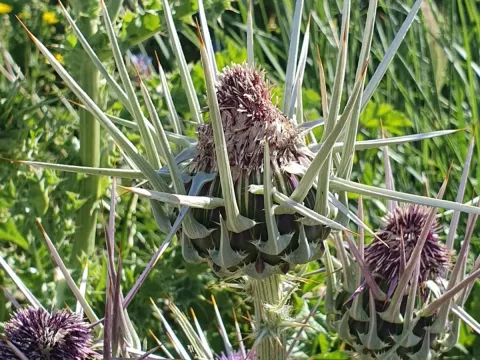
Ivory thistle
Silybum eburneum
Ivory thistle (Silybum eburneum) is a member of the Asteraceae family, widely recognized for its medicinal potential. This plant is known for its distinct ivory-colored leaf veins and prickly involucral bracts that protect the developing flowers.
What the section contains
Ivory thistle
The sowing season typically begins in early spring once soil temperatures reach a minimum of 10 degrees Celsius. In Mediterranean climates, late autumn or early spring sowings are standard to allow the plant to establish a deep root system before the onset of extreme summer heat.
Seeds should be sown in rows spaced approximately 45 to 60 centimeters apart. This spacing is vital for mechanical weeding and ensuring that each plant has sufficient access to light and nutrients throughout its growth cycle.
The optimal seeding depth ranges between 3 and 4 centimeters. Applying pressure to the soil after seeding is recommended to ensure adequate seed-to-soil contact, which accelerates germination in drier soil conditions.
Growth is generally vigorous, with the plant reaching its full vegetative maturity within a few months. Proper field density is crucial, usually ranging from 40,000 to 60,000 plants per hectare for optimal commercial yields.
Silybum eburneum thrives in sunny environments with full exposure to daylight. While it can adapt to various conditions, shaded areas significantly inhibit its growth and decrease the concentration of active compounds within the seeds.
The crop prefers well-drained, fertile soil, ideally with a neutral pH. It exhibits high drought tolerance once established, thanks to its deep taproot, which allows it to access water reserves that are unavailable to shallow-rooted weeds or other crops.
Climate adaptability is a key strength, as the plant originates from arid and semi-arid regions. However, it does not tolerate waterlogged soils, which can trigger root rot and other physiological stressors during the rainy season.
Fertilization should prioritize phosphorus and potassium to boost seed development. Excessive nitrogen fertilization should be avoided as it may lead to an overproduction of biomass at the expense of seed quality and reproductive output.
In terms of crop rotation, it is best to plant Ivory thistle after cereals to ensure a cleaner field environment and reduce the pressure of pests and diseases that might be present in the previous year's vegetation.
Powdery mildew is a common fungal threat that appears as a white coating on the leaves. It usually flourishes in environments with poor air circulation or excessively high humidity, requiring careful plant density management.
Root rots pose a significant risk, particularly in heavy soils that hold too much water. Preventive measures include ensuring good field drainage and selecting site locations that are not prone to seasonal flooding or water saturation.
Pests such as aphids and weevils are the primary threats to the reproductive health of the plant. Aphids tend to colonize young buds, sucking vital fluids and potentially transmitting viral diseases to the crop.
Weevils can directly damage the seed heads, making them unsuitable for medical processing. Integrated pest management strategies are advised, including the use of pheromone traps and encouraging natural predators within the farm ecosystem.
Chemical control must be applied with extreme caution to maintain the purity of the medicinal product. Utilizing organic-compliant insecticides or biological controls is increasingly popular to preserve the quality of the raw material.