
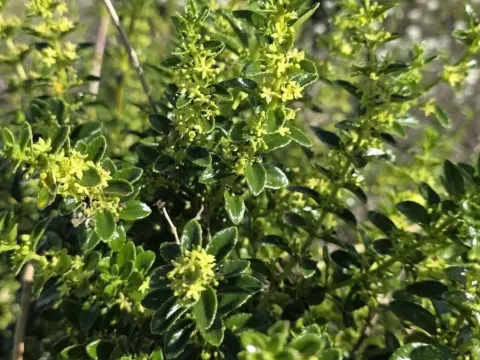
Shrubby madder
Rubia fruticosa
Shrubby madder (Rubia fruticosa) is a perennial evergreen subshrub belonging to the Rubiaceae family. Native to the Canary Islands, this plant is well-adapted to specific insular climates, demonstrating remarkable resilience and a unique growth habit.
What the section contains
Shrubby madder
The plant thrives in well-drained, stony soils with a neutral or slightly alkaline pH. It is crucial to maintain proper soil aeration, as Rubia fruticosa is highly susceptible to root rot if water stagnation occurs, especially during the wetter months of the year.
Environmental requirements include a sunny location to ensure optimal plant development. Direct sunlight is vital for the plant to reach its maturity and to maintain the concentration of phytochemicals within its rhizomes, which are essential for its traditional applications.
Cultivation practices should emphasize weed management. The species does not compete well with vigorous grasses during its establishment phase, so manual or mechanical weeding is necessary to prevent nutrient depletion and light competition around the root zone.
Temperature control is essential for this plant, as it is a subtropical species. While it is hardy, it does not tolerate severe or prolonged frosts, which can damage the stems and retard growth significantly in the subsequent season.
The primary economic use of shrubby madder is the extraction of natural dyes from its roots. These roots contain specific anthraquinones that have been historically prized for producing various shades of red, depending on the mordant used in the process.
Harvesting typically occurs when the plants are at least three to four years old. This duration is necessary to allow the root system to accumulate a sufficient mass and concentration of dye-producing pigments, ensuring a viable yield for processing.
The harvest process involves careful excavation of the soil to extract the complex root network. Care must be taken to minimize physical breakage, as the value of the final product depends on the purity and overall quality of the harvested rhizomes.
Once harvested, the roots are thoroughly cleaned of dirt and soil debris. Drying should be done in a well-ventilated, shaded environment to preserve the chemical integrity of the pigments, avoiding exposure to intense heat or direct UV radiation.
Storage of the processed product requires a cool, dry place away from light sources. Proper handling and drying ensure that the biological properties of the plant material are preserved for trade and industrial application over extended periods.