
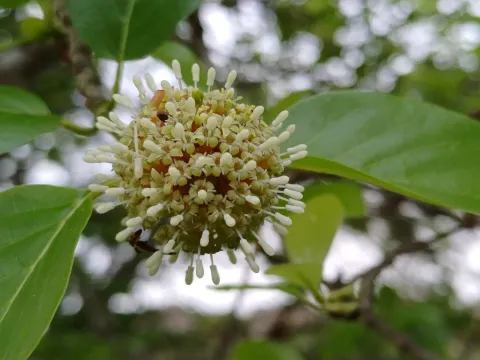
Mitragyna parvifolia
Mitragyna parvifolia
Mitragyna parvifolia is a significant tree species within the Rubiaceae family. Known for its robust structure, this deciduous tree is native to the tropical regions of South and Southeast Asia, including India, Sri Lanka, and Thailand, where it plays an ecological and economic role.
What the section contains
Mitragyna parvifolia
The tree thrives in tropical climates characterized by distinct wet and dry seasons. It requires consistent sunlight for optimal photosynthesis and growth, making it well-suited for plantations in open areas with adequate solar radiation throughout the year.
Regarding soil requirements, the species performs best on well-drained loamy soils. While it exhibits some tolerance for varying soil conditions, waterlogged environments must be strictly avoided to prevent root system suffocation and associated physiological stress.
Agricultural management includes site preparation, which involves clearing and tilling the land to promote deep root penetration. In the early stages of establishment, regular irrigation is vital to ensure survival, although mature trees develop high drought resistance.
The economic utilization of Mitragyna parvifolia is primarily focused on its durable timber, which is highly valued for tool handles, furniture, and agricultural implements. Furthermore, various parts of the tree are studied for their chemical composition and potential medicinal applications.
The primary pathological threats to Mitragyna parvifolia include fungal pathogens that thrive in high-humidity environments. Root rot and stem cankers are major concerns that can significantly impact the longevity and health of the tree if left unmanaged.
Insects, particularly defoliating caterpillars and wood-boring beetles, represent the most common biological threats. These pests can weaken the overall structure of the tree and reduce its capacity for biomass production, necessitating periodic monitoring.
Cultural control methods such as pruning infected branches and maintaining appropriate spacing between trees are fundamental to disease prevention. Enhancing air circulation within the canopy helps significantly in mitigating fungal outbreaks during the monsoon season.
For pest management, integrated pest management (IPM) strategies are recommended, focusing on maintaining biodiversity to encourage natural predators. Chemical interventions should be limited to instances where pest populations exceed economic threshold levels.
Soil health monitoring, including checking for nutrient deficiencies or toxicity, is an indirect method of strengthening the tree’s defense mechanisms. A well-nourished tree is significantly more resilient to attacks from both pathogens and insect pests.