
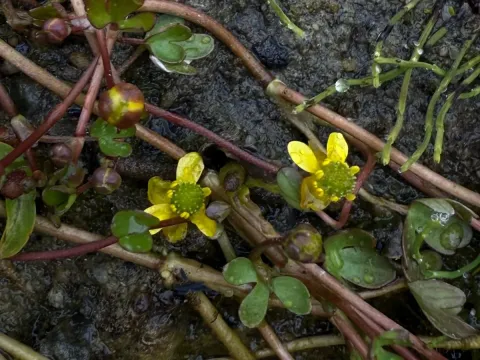
High arctic buttercup
Ranunculus hyperboreus
The high arctic buttercup (Ranunculus hyperboreus) belongs to the Ranunculaceae family. It is a perennial herbaceous plant specifically evolved for the extreme conditions of the high arctic climate.
What the section contains
High arctic buttercup
Botanically, the plant is characterized by creeping, often rooting stems that help it form mats over moist substrates. Its distribution is circumpolar, extending throughout the tundra regions of the Northern Hemisphere.
The species requires high moisture levels and is typically found along the edges of ponds, marshes, and streams. It is remarkably well-adapted to surviving extended periods of freezing temperatures and water saturation.
In an agricultural context, it serves as a valuable forage resource for reindeer herds in the tundra. Its ability to propagate vegetatively makes it a resilient plant species in harsh, nutrient-poor environments.
The plant thrives in diverse soil types, including peaty and sandy soils common in the arctic region. It initiates growth very early in the season, maximizing the short window of available heat and solar radiation.
The primary threat to the species is climate-induced thawing of permafrost, which drains the essential wetlands required for its survival.
Pathogenic threats are minimal due to the extreme climate, though mild fungal infections can occur during uncharacteristically warm summers.
Insect pests are generally not a significant factor in the high arctic, providing the plant with a degree of natural protection compared to southern varieties.
Industrial activities and soil compaction caused by off-road vehicles present a risk to local populations in vulnerable regions.
Overgrazing by local fauna in localized areas can lead to a reduction in plant biomass and slow recovery cycles.