
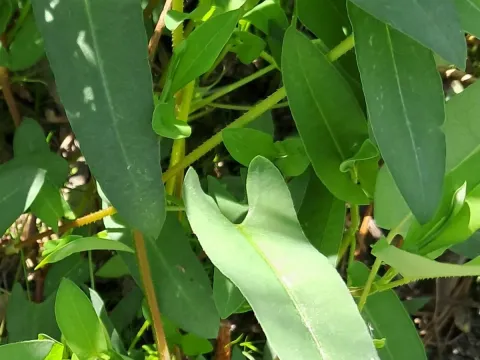
Arrowleaf tearthumb
Persicaria sagittata
Arrowleaf tearthumb (Persicaria sagittata) is an annual herbaceous plant belonging to the Polygonaceae family. Originating from East Asia and North America, it has adapted to thrive in wetland ecosystems, riverbanks, and floodplains.
What the section contains
Arrowleaf tearthumb
The plant is a strict hydrophyte, meaning its primary requirement for successful growth is consistently high soil moisture. It performs best in saturated soils where drainage is poor, effectively utilizing niche habitats that are often unsuitable for conventional cereal crops.
Botanically, it is characterized by its trailing stems equipped with recurved prickles, which allow the plant to scramble over neighboring vegetation. This unique structure allows it to dominate moist habitats by creating dense, impenetrable mats of foliage.
In agricultural and ecological contexts, it is sometimes evaluated for its role in bio-remediation or as a late-season honey source. Its rapid biomass accumulation in wet environments makes it an interesting subject for studies on wetland vegetation management.
Agrotechnical management requires precise control, as the plant can become invasive due to its prolific seed production. Farmers must ensure proper site selection to prevent it from spreading into adjacent irrigation channels or moisture-sensitive crop fields.
The plant is susceptible to various fungal pathogens that flourish in high-humidity microclimates, specifically leaf spots and powdery mildew. Pests include various sap-sucking insects and leaf miners that can impact the overall health and yield of the stand.