
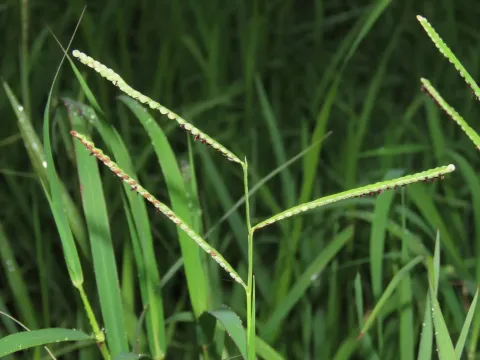
Paspalum orbiculare
Paspalum orbiculare
Paspalum orbiculare, commonly known as ditch millet, is a member of the Poaceae family. It is a perennial grass native to tropical and subtropical regions, widely adapted to diverse ecological niches.
What the section contains
Paspalum orbiculare
The plant thrives in warm climates and requires consistent moisture for optimal growth. While it is often found in moist habitats, it exhibits a significant level of resilience to varying light conditions, tolerating partial shade effectively.
In terms of soil preference, this species is not overly demanding. It adapts well to low-fertility soils, including sandy loams and acidic types, making it a valuable candidate for land reclamation and soil conservation projects.
The temperature range for its active growth cycle is typically between 20°C and 30°C. It is sensitive to frost, which limits its primary cultivation to warmer regions where it can persist as a perennial cover.
Botanically, it forms dense tufts with upright stems that can grow up to 80 cm in height. The foliage is glabrous and palatable, making it suitable for grazing livestock in various farming systems.
The primary agricultural use of Paspalum orbiculare is as a forage crop for grazing or hay production. It is highly valued for its ability to regenerate quickly after grazing or mowing, providing multiple harvests per season.
Yield potential is highly dependent on nitrogen availability and moisture supply. In managed systems, it can produce a substantial amount of green biomass, providing a reliable food source for ruminants.
The nutritional quality of the grass is best maintained when harvested during the vegetative phase. As the plant matures towards seed production, the fiber content increases and the crude protein levels decrease, reducing overall palatability.
Beyond its feed value, it plays a vital role in pasture stabilization. Its strong, fibrous root system creates a protective mat that prevents soil erosion, particularly on hillsides or near drainage areas.
It also contributes to soil health by increasing organic matter content, which improves water infiltration and aeration, thereby creating a more favorable environment for subsequent plant growth.
The plant is susceptible to various fungal pathogens, specifically rust diseases and smuts, which typically appear during periods of high humidity and poor air circulation within the canopy.
Insect pests such as grass-feeding larvae can cause localized damage to the foliage. Monitoring programs are essential to detect infestations before they escalate into major outbreaks across the pasture.
Management strategies focus on maintaining vigorous plant growth, which provides a level of natural resistance to pests. Proper stocking rates prevent overgrazing, which would otherwise weaken the plants and increase susceptibility.
Cultural control methods, such as timely mowing or controlled grazing, help to disrupt the life cycle of pests and fungal spores by removing infected biomass from the field.
Biological control and the integration of resistant varieties remain the preferred strategies for long-term management, minimizing the need for chemical interventions in a grazing environment.