
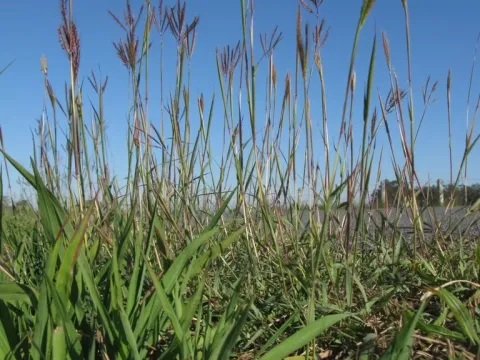
Dichanthium
Dichanthium
Dichanthium is typically sown during the spring season once soil temperatures are consistently above 18 degrees Celsius, ensuring optimal germination conditions.
What the section contains
 Angleton grass
Dichanthium aristatum (Poir.) C. E. Hubb.
Angleton grass
Dichanthium aristatum (Poir.) C. E. Hubb.
 Dichanthium annulatum
 (Forssk.) Stapf
Dichanthium annulatum
Dichanthium annulatum (Forssk.) Stapf
 Dichanthium caricosum
 (L.) A. Camus
Dichanthium caricosum
Dichanthium caricosum (L.) A. Camus
 Silky bluegrass
Dichanthium sericeum (R. Br.) A. Camus
Silky bluegrass
Dichanthium sericeum (R. Br.) A. Camus
 Silky Bluegrass
Dichanthium sericeum (R. Br.) A. Camus subsp. sericeum
Silky Bluegrass
Dichanthium sericeum (R. Br.) A. Camus subsp. sericeum
Dichanthium
Proper seedbed preparation is essential; the soil should be finely tilled and leveled to ensure uniform seed distribution and effective contact with the soil surface.
Seeding rates depend on the specific method used, but generally, a row spacing of 30 to 45 centimeters is recommended to manage density and growth habit.
Seeds should be planted at a shallow depth of 1 to 2 centimeters. Placing seeds too deep often results in poor emergence due to limited energy reserves in the seed.
Post-seeding compaction using a roller is recommended to improve moisture retention around the seeds, which significantly boosts germination rates in dry environments.
Dichanthium is a perennial grass belonging to the Poaceae family, known for its strong adaptation to tropical and subtropical climates and warm regions.
The plant exhibits high drought tolerance, making it an excellent candidate for regions with erratic rainfall patterns, thanks to its deep and resilient root system.
It thrives best in well-drained loamy or sandy soils. While it can adapt to various soil types, it performs poorly in waterlogged or swampy conditions.
Dichanthium requires significant amounts of sunlight for optimal biomass production. Shading from trees or weeds can lead to stunted growth and reduced forage quality.
An optimal soil pH range of 6.0 to 7.5 is ideal for nutrient uptake. It responds well to balanced fertilization, particularly in the initial establishment phase.
Yield potential is largely determined by environmental conditions, particularly rainfall and soil fertility. Under intensive management, it can produce substantial biomass.
Regular nitrogen fertilization is crucial for maximizing regrowth cycles, especially in pasture systems where the grass is frequently grazed by livestock.
As a forage crop, its nutritive value peaks during the vegetative stage, providing a high-protein diet that supports healthy animal development and weight gain.
Effective pasture rotation allows for higher yields, as it gives the grass sufficient recovery time between grazing bouts to replenish root reserves.
Dry matter yields are highly consistent when irrigation or optimal moisture is available, making it a reliable feed source for year-round agricultural operations.
Like many tropical grasses, Dichanthium can be susceptible to various fungal pathogens, such as rusts and smuts, especially during prolonged humid weather.
Pests, including leaf-sucking insects and root-feeding larvae, can negatively impact crop health if their population densities are not controlled effectively.
Integrated pest management strategies should focus on maintaining a healthy plant stand through proper grazing intensity and appropriate nutrient levels.
- Regular field inspections for early signs of disease.
- Selection of resistant cultivars if available in the region.
- Mechanical weeding or limited chemical control to suppress invasive weeds.
- Maintaining optimal stocking rates to prevent pasture degradation.
Implementing these protective measures helps ensure the longevity of the crop and prevents the build-up of damaging populations of diseases and insects.
For high-quality hay, the crop should be harvested at the early flowering stage, which ensures the best balance between biomass quantity and protein content.
When ensiling, the crop must be chopped to a consistent size to facilitate proper packing and anaerobic fermentation within the storage facility.
Seed harvesting requires careful timing; producers should aim to collect seeds when the panicles have turned color but before significant shattering occurs.
Pasture management requires rotational grazing to ensure the grass is not over-grazed, which would otherwise weaken the stand and allow weeds to establish.
Proper post-harvest storage is vital for hay quality; keeping the product in dry, well-ventilated sheds prevents molding and nutrient degradation over time.