
Desert Bluegrass
Bothriochloa ewartiana
Description
Growing requirements
Desert Bluegrass (Bothriochloa ewartiana) is a perennial grass belonging to the Poaceae family. Native to the arid and semi-arid regions of Australia, it is highly valued for its persistence and ability to provide nutritious grazing in challenging environments.
This grass is well-adapted to tropical and subtropical climates, thriving in areas with summer-dominant rainfall. It exhibits remarkable heat tolerance and can survive intense sunlight, making it a key species for land restoration and livestock feed.
The species prefers well-drained clay or loamy soils. It has a deep-reaching root system that allows it to access stored soil moisture during periods of prolonged drought, ensuring survival where other forage species might fail.
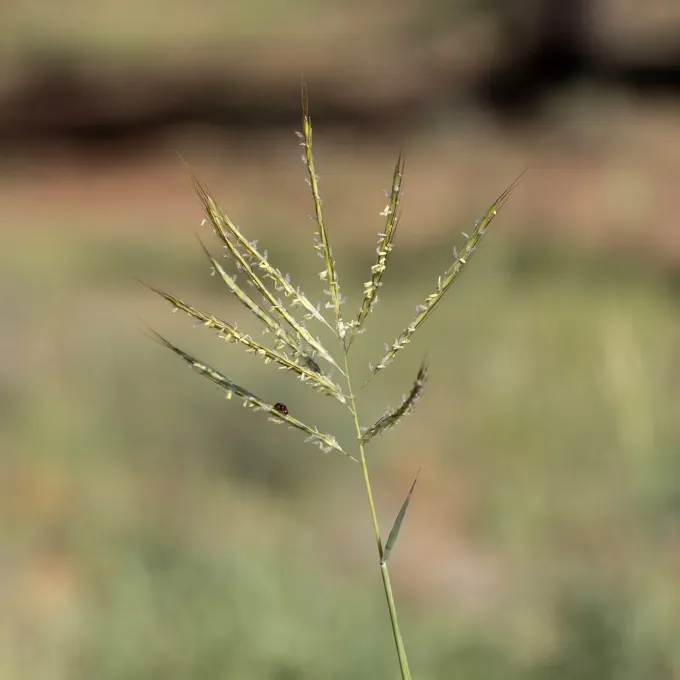
Botanically, it forms dense, tussocky clumps that can reach up to a meter in height. Its foliage is characterized by a distinctive blue-green tint, while its reproductive structure consists of attractive, feathery racemes that disperse seeds effectively.
In agricultural practice, it is primarily used for extensive cattle and sheep grazing. It is known to retain good feed quality during the growing season, contributing significantly to the productivity of rangelands in dry regions.
Main diseases and pests
The main threat to the sustainability of Desert Bluegrass is overgrazing, which reduces the plant's vigor and allows less desirable weed species to encroach on the pasture.
Disease pressure is generally low due to the plant's native adaptation, although fungal leaf spots may occur during periods of unseasonable high humidity or excessive rainfall.
Insect pests, such as grasshoppers and larvae, can occasionally cause damage to foliage. However, well-managed pastures usually support natural predators that keep these pest populations in check.
Management practices should focus on maintaining a balanced stocking rate. Allowing the grass to complete its flowering cycle occasionally is crucial for maintaining the seed bank and long-term population health.
Environmental stressors like long-term soil degradation can impact its growth, so rotational grazing is recommended to ensure the plant maintains its dominance within the local forage ecosystem.