
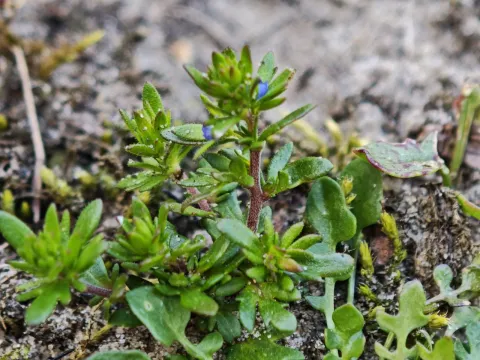
Spring speedwell
Veronica verna
Spring speedwell (Veronica verna) is an annual herbaceous plant belonging to the Plantaginaceae family. It is recognized as a typical ephemeral weed that completes its life cycle during the early spring months, before high temperatures and soil moisture deficits occur.
What the section contains
Spring speedwell
The native range of this species covers Europe, temperate Asia, and parts of North Africa. It thrives in well-drained, sandy, or light loam soils. The plant is commonly found in winter cereal fields, pastures, and disturbed ground where competition from taller vegetation is initially limited.
Botanically, this plant is characterized by an upright stem covered in glandular hairs, reaching up to 15 centimeters in height. Its leaves are deeply lobed, and the small, bright blue flowers are arranged in terminal racemes, which are a distinctive feature of the species.
The plant has specific climatic requirements, favoring cooler, damp spring weather. It is highly photophilic and is generally unable to survive in shaded environments. This trait makes it particularly successful in winter crop fields before the crop canopy closes.
Agronomic management relies on timely tillage operations, particularly pre-sowing cultivation, to terminate seedlings. For chemically intensive operations, contact or systemic herbicides should be applied during the early growth stages to maximize efficacy.
The primary agricultural threat posed by Spring speedwell is its role as a resource competitor. By utilizing available soil moisture and nutrients early in the season, it can inhibit the development of young crop seedlings, leading to reduced final yields.
Veronica verna serves as a host plant for various plant pathogens, including certain types of powdery mildew and viruses. By harboring these diseases, it acts as a green bridge, facilitating the transfer of pathogens to the primary crop.
Insects, particularly aphids, may inhabit the plant during its growth phase. While the damage to the weed itself is negligible, the presence of these pests on the field can lead to significant infestations of neighboring cereal crops.
To reduce weed pressure, farmers should focus on maintaining a competitive crop stand. Rapid establishment of winter crops helps to shade out the weed, significantly reducing its ability to reach the seed-production phase.
Integrated weed management (IWM) strategies are recommended, combining mechanical soil disturbance with chemical control. Avoiding monoculture is also essential to disrupt the reproductive cycle of this prolific seed producer.