
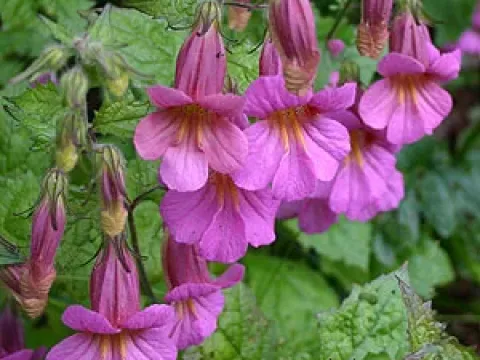
Rehmannia
Rehmannia
Rehmannia (Rehmannia glutinosa), a member of the Orobanchaceae family, is a perennial herb primarily cultivated for its medicinally active roots. Successful cultivation requires careful attention to the propagation phase.
What the section contains
Rehmannia
Seeds are extremely small and should be sown in spring within nursery beds or greenhouses. Surface sowing on a moist, fine-textured substrate is necessary to ensure uniform germination, as seeds require light to sprout.
Seedlings are transplanted into the open field once the risk of frost has passed. Planting density is typically set to maintain proper airflow, usually with spacing of approximately 30 cm between plants and 40 cm between rows.
Vegetative propagation using root cuttings is a common and efficient method in commercial farming. Cuttings of healthy roots, 5-8 cm in length, are planted directly in fertile, well-prepared soil.
Crop rotation is essential. Rehmannia should not be planted on the same plot for at least four years to reduce the risk of soil-borne pathogens accumulating in the ground.
This plant thrives in sunny, well-ventilated locations. While it prefers full sun, some partial shade during the hottest part of the day can be beneficial in warmer climates to prevent stress.
Soil quality is paramount; sandy loams that are rich in organic matter are ideal. The substrate must provide excellent drainage, as Rehmannia is highly susceptible to root rot if water stagnation occurs.
Optimal pH levels for the crop range from 6.0 to 7.0. Soil preparation includes deep plowing and the incorporation of mature compost to ensure a nutrient-dense environment for root development.
During the growing season, moderate and consistent moisture is required. Irrigation should be managed carefully to avoid excessive saturation, which is a frequent cause of crop failure.
Temperature management is key; the plant performs best in temperatures between 20 and 25 degrees Celsius. Protection from harsh winds is recommended to preserve leaf integrity and moisture balance.
The economic value of Rehmannia lies in its fleshy tuberous roots, which are harvested after one to two years of growth. Yields vary significantly based on soil fertility and irrigation efficiency.
To maximize root biomass, it is common practice to remove flower buds throughout the growing season. This prevents the diversion of metabolic energy from the root system to the reproductive structures.
On well-managed plantations, yields can reach 2 to 3 metric tons of dried root per hectare. Proper post-harvest handling is critical to ensure the quality required by pharmaceutical standards.
Quality control during grading is vital. Larger, cleaner, and more uniform roots command higher market prices, making meticulous harvesting and processing a high priority for commercial growers.
Regular monitoring of plant development and adjusting nutrient supplies, especially potash levels, can significantly enhance the accumulation of iridoid glycosides in the final product.
Fungal diseases, including Fusarium wilt and various root rots, are the most significant threats to Rehmannia crops, usually triggered by poor drainage or excessive soil moisture.
Nematodes are another serious concern, as they damage the root cortex, reducing both the quantity and quality of the harvest. Integrated pest management (IPM) is essential for control.
Leaf-feeding insects, such as caterpillars and aphids, can cause significant damage to the foliage, which reduces the plant's photosynthetic capacity and ultimately hinders root growth.
Maintaining a clean, weed-free environment is critical, as weeds often act as hosts for viruses and insects that can negatively impact the Rehmannia crop.
- Implement strict field sanitation practices.
- Use certified disease-free planting material.
- Apply preventative organic fungicides if humidity levels are high.
Harvesting typically occurs in the autumn, when the leaves begin to yellow and wither. This physiological signal indicates that the plant has stored maximum nutrients in the roots.
The roots are carefully lifted using forks or mechanical diggers, ensuring minimal skin damage. Even minor abrasions can lead to decay during the drying process or storage.
Immediately after harvesting, the roots must be thoroughly washed to remove soil and debris. Sorting by size and quality is then performed to prepare the crop for primary processing.
Drying is a critical stage. It is usually performed in temperature-controlled rooms or specialized dryers to ensure that the active compounds, such as catalpol, remain stable.
Final storage requires cool, dry, and well-ventilated conditions. The product should be kept in breathable packaging to prevent moisture accumulation and preserve the integrity of the bioactive compounds.