
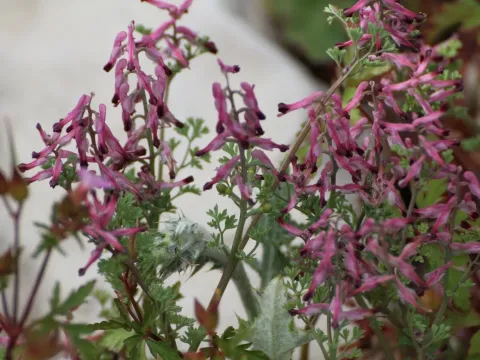
Fumaria calcarata
Fumaria calcarata
Fumaria calcarata is an annual herbaceous plant belonging to the Poppy family (Papaveraceae). It is primarily recognized as a wild weed that competes with agricultural crops for nutrients, water, and sunlight during the initial growth phases.
What the section contains
Fumaria calcarata
The plant thrives in well-drained, fertile soils with a neutral pH, often appearing in cultivated fields where nutrient density is high due to fertilizer application. It prefers temperate climates with consistent moisture availability.
Morphologically, Fumaria calcarata is distinguished by its branched stems and unique flowers equipped with spurs, which give the plant its characteristic appearance. It possesses a shallow but efficient root system capable of rapid nutrient uptake.
Environmental requirements include sufficient light exposure, as the plant is not shade-tolerant. It performs best in open field conditions where the canopy of the main crop is not yet fully closed, allowing the weed to establish dominance.
Agronomic management relies heavily on mechanical weeding and soil cultivation practices. Since the plant produces a large number of seeds, suppressing it before anthesis is essential to prevent long-term soil seed bank accumulation.
While relatively robust, Fumaria calcarata can be susceptible to various fungal pathogens, such as powdery mildew, which thrives in humid conditions and can inhibit plant development.
Several insect pests, particularly those targeting generative organs, may utilize the plant as a food source. This can occasionally limit seed dispersal, but it is rarely enough to provide complete biological control.
Agricultural threats also include the potential for the plant to act as an alternate host for viral pathogens that might eventually affect high-value crops in the vicinity.
Integrated weed management (IWM) strategies are recommended, combining mechanical, cultural, and chemical controls to minimize the economic threshold of the weed within the field.
Regular monitoring of field edges and buffer zones is critical, as these areas often serve as primary reservoirs for the colonization of Fumaria calcarata into the center of the crop fields.