
Purple toothwort
Lathraea clandestina
Description
Growing requirements
Purple toothwort (lat. Lathraea clandestina) is a distinctive perennial achlorophyllous plant belonging to the Orobanchaceae family. It is strictly a parasitic organism and is not cultivated as a commercial agricultural crop.
The plant is native to Western Europe, with its natural range including countries such as France, Belgium, and Spain. It primarily thrives in damp, shaded forest environments, particularly near rivers and streams where potential host trees are abundant.
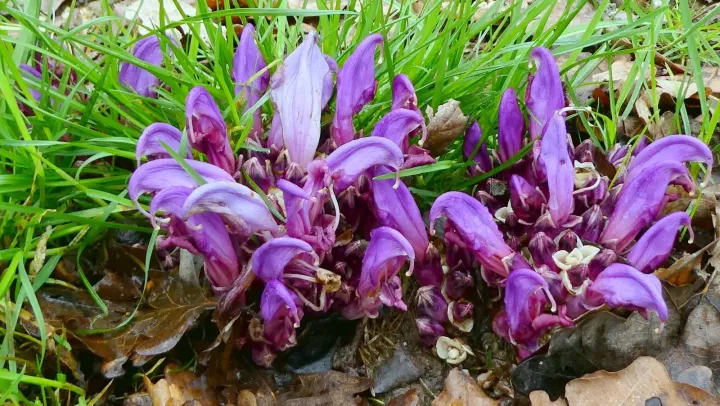
Botanically, the species is defined by its lack of chlorophyll and its specialized underground rhizome. The plant remains hidden beneath the soil, surfacing only to bloom with vibrant purple flowers that protrude just above the leaf litter.
Environmental requirements are strict: the species depends entirely on root contact with host trees like willow, poplar, or alder. It utilizes specialized organs called haustoria to penetrate the host's roots and extract essential water and nutrients.
There is no agricultural management associated with this plant. It is considered a botanical curiosity rather than a crop, playing a niche ecological role in deciduous woodlands where it interacts directly with the root systems of mature trees.
Main diseases and pests
Environmental threats to the species primarily involve habitat destruction and alterations to river ecosystems. Because it relies heavily on specific host trees, any deforestation or drainage projects can lead to the rapid decline of local populations.
The plant does not face significant pest pressure as it spends the majority of its lifecycle subterranean. Pathological threats are generally limited to climate-related stresses that disrupt the symbiotic-parasitic balance between the toothwort and its host tree.