
Japanese toothwort
Lathraea japonica
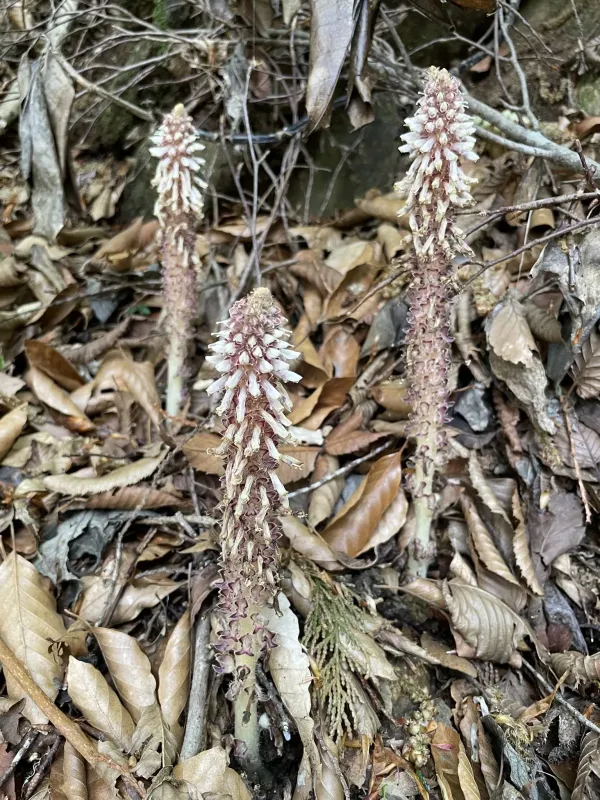
Description
Growing requirements
Japanese toothwort (Lathraea japonica) is a fascinating perennial plant belonging to the Orobanchaceae family. It is an obligate holoparasite, meaning it completely lacks chlorophyll and cannot perform photosynthesis.
The native distribution of this plant covers parts of East Asia, primarily Japan. It typically inhabits moist, shaded forest floors where it establishes a parasitic connection with the roots of specific host trees, such as alders and willows.
The plant requires high levels of humidity and stable soil moisture to survive. It is shade-tolerant and usually thrives in environments with minimal direct sunlight, which protects it from desiccation.
Its life cycle involves spending the majority of the year underground as a fleshy, scale-covered rhizome. This rhizome uses specialized organs called haustoria to extract nutrients directly from the host plant's vascular system.
While Japanese toothwort is not a commercial crop, it is a subject of interest in botanical studies regarding parasitic plant evolution. Its ecological significance lies in its unique role as a specialized component of the temperate forest biodiversity.
Main diseases and pests
The primary threat to the stability of Lathraea japonica populations is the destruction of its habitat, specifically the deforestation of host tree species that it relies upon for nutrient uptake.
Climate change, leading to altered precipitation patterns, poses a significant risk as the plant requires specific soil moisture levels to maintain its underground connections with the host roots.
Soil-borne pathogens represent a threat, particularly in environments where human interference leads to poor drainage and water stagnation, promoting rot in the rhizomes.
While there are few specific agricultural pests for this wild species, general herbivory can occur when the plant emerges for its short flowering season to reproduce.
In terms of conservation, the fragmentation of forest ecosystems limits the plant's ability to propagate effectively, potentially isolating populations and reducing their genetic diversity.