
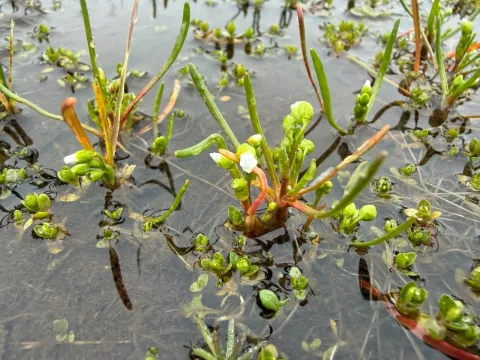
Montia linearis
Montia linearis
Montia linearis is an annual herbaceous plant that typically completes its life cycle during the cool spring season. Seeds should be sown directly into well-prepared soil once the frost danger has passed and temperatures consistently reach 5–8 degrees Celsius.
What the section contains
Montia linearis
In regions with milder winters, fall sowing is possible to ensure early spring harvest. The seeds are very fine, so they should be covered with only a thin layer of fine soil or compost, no more than 0.5 centimeters deep, to facilitate germination.
A sowing density of approximately 200–300 seeds per square meter is recommended to achieve a uniform stand. Consistent soil moisture is crucial during the first two weeks to ensure successful sprouting and emergence.
Once seedlings have developed their first true leaves, thinning is necessary. Spacing plants about 5 to 7 centimeters apart promotes better air circulation and prevents overcrowding, which can lead to elongated, weak stems.
The plant thrives in cool conditions, and therefore, early spring sowing is prioritized over late season planting, which might lead to rapid bolting when temperatures rise significantly.
Montia linearis belongs to the Montiaceae family and is native to western North America, where it thrives in environments with high humidity and moderate temperatures throughout its growing season.
The plant prefers well-drained, sandy or loamy soils with a neutral or slightly acidic pH. Poorly drained soils often lead to crown rot and stunted development, making soil preparation essential for success.
While the plant requires sufficient sunlight for vigorous growth, it is sensitive to intense heat. Providing light shade during the hottest part of the day can help maintain leaf quality and prevent premature bolting.
Water management is the most critical factor; the soil must be kept consistently moist but not waterlogged. Drip irrigation systems are highly effective in maintaining the required humidity levels without wetting the foliage excessively.
Fertilizer application should be moderate. An excess of nitrogen will produce overly lush foliage at the expense of flavor and structural integrity, increasing the risk of the plant collapsing during the maturation phase.
The primary threats to Montia linearis include fungal diseases, specifically powdery mildew and root rot, which are triggered by stagnant air and excessive moisture levels within the plant canopy.
Slugs and snails are the most common pests, as they are attracted to the succulent, tender leaves. They can cause severe damage in a short period, especially in damp conditions during early spring.
To mitigate disease risks, it is essential to ensure proper spacing between plants and avoid overhead watering, which keeps the foliage wet for prolonged periods and encourages the spread of spores.
Integrated pest management strategies, such as using physical barriers for slugs or biological controls for aphids, are preferred over chemical pesticides, as the leaves are typically consumed in their raw form.
Maintaining a clean garden bed and implementing a crop rotation system helps to disrupt the life cycles of common soil-borne pathogens that might otherwise thrive in continuous plantings of the same area.
Harvesting Montia linearis is best timed when the plant has formed a full rosette of leaves, but immediately before the plant begins to bolt and produce flowers, as the flowering process significantly reduces leaf quality.
The entire rosette can be harvested by cutting at the soil line with a sharp knife, which minimizes tissue damage and ensures the harvested leaves remain clean and free from soil debris.
Harvesting should ideally occur in the early morning, as the plants are most turgid and flavorful during this time, resulting in a higher quality product that retains freshness longer post-harvest.
Post-harvest care involves immediate cooling of the leaves to remove field heat, as Montia linearis is highly perishable and prone to wilting if exposed to ambient temperatures for extended periods.
For market-ready distribution, the harvested greens should be stored in ventilated containers at temperatures between 1 and 3 degrees Celsius, ensuring they remain crisp until the final consumer receives them.