
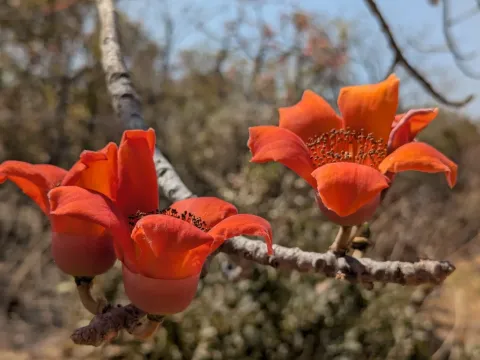
Bombax
Bombax L.
Bombax (Bombax L.) is a genus of deciduous trees belonging to the Malvaceae family. These large, imposing trees are native to tropical regions of Africa, Asia, and Australia, where they thrive in warm, humid climates with distinct seasonal patterns.
What the section contains
Bombax
The trees require full sun exposure and consistent high temperatures to maintain healthy metabolic activity. They are best suited for tropical landscapes and plantations that experience a clear cycle of rainy and dry seasons, which is essential for their leaf-shedding behavior.
Soil quality is paramount for Bombax development. The ideal substrate is deep, fertile, and provides excellent drainage. Because the root system is sensitive to waterlogging, planting on heavy, stagnant clays must be avoided to prevent root diseases.
Agrotechnical management involves careful selection of planting sites to ensure ample space for growth. As these trees can reach significant heights and widths, spacing between individuals must be sufficient to allow for canopy development and sunlight penetration.
Maintenance tasks include regular pruning, especially for younger trees, to shape the crown and facilitate access for future harvesting. Nutrients should be balanced to support both rapid biomass growth and seed production during the cycle.
The primary agricultural product derived from Bombax is the silky fiber found inside the seed pods. Similar to kapok, this fiber is valued for its remarkable buoyancy, water resistance, and thermal insulation capabilities.
This natural fiber is widely used in the manufacturing of life-saving equipment, specialized bedding, and high-performance garments. Its resistance to clumping makes it a premium stuffing material in the upholstery industry.
Beyond the fiber, the wood of the Bombax tree is prized for its low density and ease of processing. It is frequently utilized in the production of lightweight plywood, shipping crates, and various decorative items that do not require heavy structural support.
The seeds of the plant serve as a secondary source of income, as they contain oil that can be extracted for industrial applications, such as soap making or the production of organic lubricants.
Annual yields depend heavily on climate stability and the age of the plantation. Efficient harvesting processes often involve manual gathering or the use of light mechanical tools to reach high branches without damaging the protective bark.
Bombax trees are susceptible to several pests, including wood-boring beetles that can cause significant damage to the trunk and branches if left untreated. Regular monitoring is essential to detect infestations in the early stages.
Fungal pathogens represent a major threat, particularly during the wet season. Diseases like root rot and fruit mold can quickly compromise yields if the plantation lacks proper ventilation or efficient soil drainage systems.
Nematode infestations in the soil can stunt the growth of young trees. To mitigate this risk, farmers often perform pre-planting soil treatments and ensure the use of certified, resistant nursery stock to prevent the spread of parasites.
Viral infections may occur, leading to chlorosis or deformed leaf patterns. Management strategies focus on controlling insect vectors, such as aphids or whiteflies, which are common carriers of plant-based viruses in tropical environments.
Wildlife, particularly birds and small mammals, can damage maturing pods. Protective netting or noise-based deterrents may be necessary in areas with high levels of local fauna to ensure the fiber remains intact for harvest.